Who doesn't love to do a little shopping in a foreign country. Those of you that know me, know that this is one of my favorite things to do...no matter where I am. :-) I do try and contain myself and stick to items that are relevant to the country and our "chosen" souvenir.
After talking with other avid travelers we decided early on, unfortunately after we had already traveled a few times, that we needed to have a common themed souvenir that we would try and look for in each new location. This was two fold. First of all, it deterred from the kids asking for every thing that they saw with the name of the place we were in and secondly, it made for a nice collection, rather than random souvenirs. We don't always find our particular type souvenir in each new place, but that is par for the course.
Chad's "chosen" souvenir is probably the hardest to find and mine coming in at a close second. The kids have "chosen" wisely as theirs are found in just about every spot. Chad has decided to get a souvenir Hard Rock glass in each place that has a Hard Rock. He has racked up quite the collection and of different styles of glasses. This will all add to his "man cave" at some point. :-) I chose to collect watercolor scenes in hopes to have a "true" travel wall someday. Tanner decided on key chains and Ellie on snow globes. We also, sometimes, venture off our beaten path and get something that is unique to that country.
The fun thing about cruises is that you can accumulate quite the collection during all the different ports. Our first port was Messina, Italy on the Island of Sicily. We visited Mt. Etna and the village of Taormina. On our tour our guide mentioned that Sicily is often represented by a three-legged woman, known as the trinacria. The three legs symbolize the three coastlines of Sicily with a head at it's center. The three coastlines are considered as gorgeous as the legs of a beautiful woman.
The three-legged trinacria, here, is made in a Gaudi style. I actually collect figures in this style, so I was thrilled to see this. I have several from Spain, such as: Don Quixote, a flamenco dancer and a bull fighter. Whenever I see one in another place I scoop it up.
In Rick Steves' guides he usually includes a section on shopping and what items to look for in each area, but since we didn't have a Rick Steves guide for Sicily, we just stuck to our tried and true, key chain, globe and print.
In Athens we didn't have a whole lot of time to shop. Some of the authentic items that Rick Steves recommends in Athens include: jewelry, sandals, carpets, religious items and worry beads.
It is no secret that the tour guides in some locations are in cahoots with a local shop owner. In Athens, it was no different. During the tour, our guide passed around a piece of jewelry that was popular amongst tourists. It was a charm that had your name written in Greek on one side and in English (or your native language) on the backside. After the Acropolis our guide brought us directly to a "select" shop that sells these and guarantees to have them ready before the cruise ship disembarks that evening. I admit, we fell into this scheme. I knew I wouldn't wear anything like this, but the woman mentioned that they could turn them into key chains for the kids. Well, this was a super unique souvenir. We all agreed this was going to be their souvenir and they would have to fore go their traditional one. I found some great prints, but couldn't chose just one.
Staying on the theme of tour guides in cahoots with a local trade, was VERY apparent in Turkey. Our tour ended with a tour of a "traditional" Turkish Carpet shop. We were basically wined and dined and then the bargaining began. We already knew going into this location that we were NOT in the market for a Turkish Carpet. After speaking to some other passengers on the ship, it turns out that EVERY tour ended with one of these presentations at a Turkish Carpet spot. Rick Steves warns you of this in his book, so we were prepared to just walk away, which we did, but I do have to say the presentation was really interesting.
The story goes...Carpet making is a dying trade. These warehouses or family owned business/franchises or whatever you want to call them, provide woman in tiny villages with the training and supplies in order to keep this trade alive. Again, after talking with other passengers, this was the same story they got. Who knows if it is true or not. The materials that this particular shop used were wool, silk and cotton/wool blend. They did a small demonstration on the process of collecting the silk. Ellie thought this was fascinating because in her 2nd grade class, last year, they studied silk worms. Her class actually had a bunch of them, fed them, watched them build their cocoons and then turn into moths and fly away.
The cocoons are very tightly wound. There is no way you can pull the threads out of them. So they have to soak the cocoons in hot water first. Being so tightly wound, they still cannot find an end to the cocoon. They take a wooden broom looking thing and begin to tap down on the cocoons until the threads catch. They then thread those threads onto a wheel. This wheel would spin the silk threads into a much stronger thickness. It really was amazing.
They also demonstrated how the carpets are made. A woman at a loom was actually tying little knots of thread making the pattern and then she would shave off the pieces sticking up making the top of the carpet a smooth surface. It is said that Turkish carpets are made differently from rugs anywhere in the world. They are double knotted, making them sturdier and more durable. Rugs elsewhere are said to be tied with a single fiber per vertical thread. Who knows, but they were impressive. Now for the ultimate presentation...
The owner of the shop began rolling carpet after carpet out. Don't get me wrong, these things were incredibly beautiful and intricate. If I was rich beyond my wildest dreams I may have considered, but that is not the case. Plus, as Rick Steves states...there is no way you can come to Turkey and get a good deal on a rug in 4 hours. As added marketing, they got the kids involved. They had them take their shoes off and run all over the carpets. The kids were the perfect tool, they ooohhheed and aaahhhheeedd all over the rugs. This allowed the presenter to then go into how to clean the rugs with kids and yada yada yada. Our kids were in love with the rugs and would have chosen every single one if we let them. As soon as the presentation was over and they invited you to go through "those" doors and look at many more and talk with one of "their guys", we were out of there. We ran for the door. Just to give you an idea of the price tag. We turned over a rug that was 100% silk and was maybe a 3 foot x 5 foot size..it was $16,000. We didn't even stay to be offered a good price, but after talking to other passengers, they said that as soon as they walked away, the price dropped by 50%.
The other shopping experience in Turkey is their bazaar style shopping. We were told that you always bargain in Turkey. I hate this. I don't feel comfortable bargaining and I just don't care for the whole thing. Funny story...after leaving the ruins of Ephesus we were walking back to our bus. Between the point where you leave the ruins and the parking lot was a huge bazaar. There were vendors on either side and they are selling everything you might need from Turkey. They are also VERY aggressive. There is definitely not a "Just looking" response. Once you pick up something they start yelling out prices and I found it really uncomfortable. So, we found a spot that had globes and key chains. Chad decided that he was going to "bargain". All of this bargaining was going to be over about a euro or so. I am saying, "Are you kidding me". Ellie is always indecisive when it comes to her globe choice and she always T A K E S F O R E V E R. This was causing me major stress here because the shop owners were hovering over us and every time she would pick one up to look at the owner would holler out a price. At this point I am like: Just pick one already and lets get the heck out of here. Well once we got back to the ship we unpacked the items and...
Look closely. Ummm....yeah...that is exactly what you think it is. Chad and I about died. Why on earth would this be on a globe of Turkey and Ephesus. Well it is what it is at this point and thankfully she hasn't really noticed. I just made sure it was turned the other direction on her shelf. HOLY COW!!!!
The Turkish evil eye was another symbol that we saw all over Turkey, and Greece, for that matter. These evil eye beads go back thousands of years. It is said to protect. We received a pin with an evil eye on it as part of our tour and Tanner picked a great key chain featuring the evil eye and the flag of Turkey, much more appropriate than his sister's choice.
Our stop on the Island of Crete was really a bust. We didn't find anything that fell into our categories. I did score some olive oil soap in one of the little villages we stopped at. They were only 1 euro a piece. I was thrilled.
Rome was a place to score a smorgasbord of trinkets. We were good and stuck to our usual's. Chad was able to get one of his glasses at Hard Rock as well.
Venice is where we fell off the wagon a bit. Hahaha. In the Shopping in Venice chapter of Rick Steves' Mediterranean Cruise Ports he says, "Long a city of aristocrats, luxury goods, and merchants, Venice was built to entice. While no one claims it's great for bargains, it has a shopping charm that makes paying too much strangely enjoyable. Carnevale masks, lace, glass, antique paper products, designer clothing, fancy accessories, and paintings are all popular with tourists visiting Venice." He wasn't kidding. We fell for the trap in a few places, but at the end of the day, we are happy with what we brought home.
Though you can probably buy Venetian Glass all over the world now, there was just something about going through the factory and drooling over all the beautiful pieces. We, obviously, weren't going home with one of their remarkable chandeliers, but we did want to leave with some nice pieces, that we could carry onto the airplane, I might add. We chose a beautiful pitcher and 8 glasses. We originally had 4 glasses (one we each picked out), but then the bargaining began. I was eyeing the pitcher and the salesman started lowering the price of the pitcher if we bought more glasses and then he gave us a package deal. Though, we are afraid to use them, for fear of one getting broken, we are excited with our Venetian luxury purchase.
This year is Chad and I's 15th Wedding Anniversary and though the traditional gift is crystal, we are going with Venetian Glass. :-)
One of the other "luxuries" I couldn't resist was a leather jacket. I had eyed one in Greece and then regretted not buying it for such a good price, so when I saw this one, in one of the many leather shops in Venice, I couldn't resist. I was told that I have to put it away until my birthday in September...Deal!
Honestly, normally, I wouldn't look at things like this, but as Rick Steves said...there is just something about Venice. :-)
The kids scored some pretty great items as well. Because we were such GREAT customers at the Glass Factory they threw in a couple of their glass signature pieces, the horses, free of charge. The kids were over the moon about this, while Chad and I were like, "They better give us a gift with purchase". Hahahaha. The kids also loved the masks, but we didn't think it was practical to have these super fancy masks that they couldn't really use, because they were too fancy. So, as we were walking through the cute little mask shop we saw plain ones that you could decorate yourself. Well this was right up our alley. They were cheap and the kids could make them whatever they wanted and not be afraid to actually use them. Win, win in my book. They were also able to find their usual's and Chad got his Venice Hard Rock glass. It was a good thing we were so good in all the other places because by the end of our Venice trip we were glad we had all the extra space in our suitcases.
Well, we certainly got some pretty nice souvenirs of our great vacation. I always hope that our choices are ones that we will be able to enjoy for a long time to come.
Showing posts with label cruising. Show all posts
Thursday, August 15, 2013
Monday, August 12, 2013
Hot as Hades Tour Final Port: Rome
The sun has set on our cruise vacation for the Summer of 2013.
We have now arrived at our starting port city of Rome, where we begin our post cruise vacation visiting Rome and Venice. :-)
This was an early departure from the boat. We had to be up and out by 7:15 am. Yikes!!!! The port city near Rome is called Civitavecchia and is a good hour/hour and a half from Rome. We had to get off the boat and retrieve our luggage from the designated area and get on our bus. The departure routine is pretty organized. You have to set all your luggage out the night before, with the tags that your stateroom attendant leaves for you. By morning, your luggage is whisked away and waiting for you off the ship, to retrieve.
On the bus ride in to Rome our guide gave us numerous tid bits about Rome. The one piece that became clearly evident very quickly was that everybody had a car, but there wasn't anywhere to park all the cars.
Our first destination on our tour was Vatican City. I didn't realize that Vatican city is actually a sovereign state and the smallest one at that, guarded by Swiss guards. Once we reached Vatican city we met up with a local tour guide. I am thankful that we arrived to the Vatican pretty early, for European standards, because there was not yet a line to get into St. Peter's basilica. We wandered through the barricades on St. Peter's Square and made it to the Swiss guards, whom were very strict on the dress code, as they should be, no knees or shoulders showing. They had no problem turning people away. Once inside the complex we were only given 20 minutes inside St. Peter's basilica, but what can you expect when we still had to see the Roman Forum and the Colosseum, all by 1:00 in the afternoon and it was now 9:30 am. It is absolutely impossible to take all St. Peter's has to offer in just 20 minutes, but again, it is what it is.
St. Peter's basilica is the greatest, largest basilica of the Christian world. When inside the basilica you can see markings on the floor to show where other churches in the world would end if they were placed inside the basilica. I was trying to buzz around the basilica as quickly as I could, taking in every nook and cranny I could reach. Ellie wasn't feeling well, as she was a bit overheated from the walk there and waiting in the short line, so a chunk of our time there we were dealing with a possible mad dash to the restroom, but thankfully that didn't happen and she was able to cool down once inside. The inside is just incredible. When you first walk in, off to the right, is the famous piece by Michelangelo, Pieta.
Like I said, this place was incredible. You just cannot even put into words how incredible it is.
Back outside, with a few minutes in the shade, to take in all the glory of St. Peter's square itself.
Back on the bus, and cooling off, we were off to our next location: Ancient Rome. As the bus drove us throughout the city we saw some other monumental buildings. I am glad that I attempted to take pictures through the window of the bus, because we didn't make it back to these areas for another photo op.
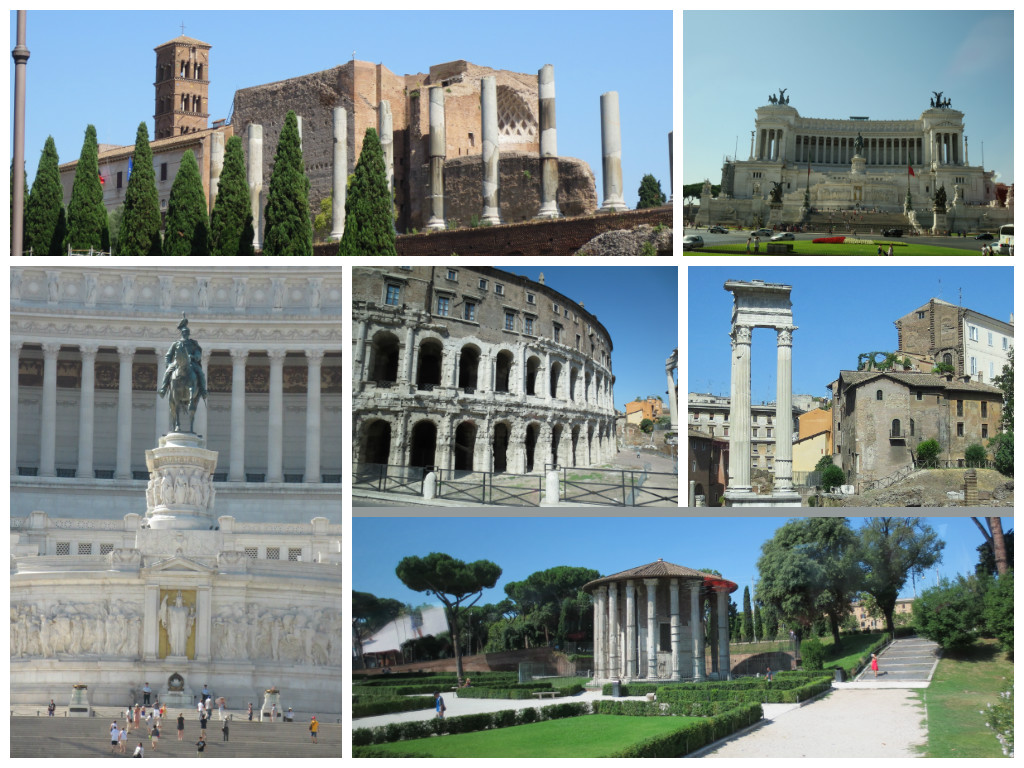
I am not sure what all of these sights are, but the upper right-hand corner and a close up in the lower left-hand corner is the Victor Emmanuel Monument. This ginormous monument was built to celebrate the 50th anniversary of the country's unification in 1861 and was dedicated to the first king of Italy. The middle picture is part of the Colosseum.
The bus let us off in the midst of the Ancient Rome area and we began our next portion: The Roman Forum and The Colosseum. Now, mind you, it was about 11:00 am now and holy cow, it was Hot as Hades.
The Roman Forum is ancient Rome's birthplace and civic center. If there was anything important happening in Rome, it was happening here. There are many things to see in this area. I did not have my trusted Rick Steves' guide, so I really can't say what all we were seeing. We did have a guide telling us what things were, but honestly, it was so hot, I just can't remember. Here is, at least, a collage of the photos I took. You can always find more information on the internet regarding this sight, but this is all I got. :-)
After leaving the Roman Forum, we walked/bustled across the street to enter the Colosseum at our slotted time frame. This was certainly the beauty of having a guide, she had everything pre-arranged so we didn't have to wait in any lines...and let me tell you...the line to get into the Colosseum was INSANE! It was so insane I couldn't even get to my camera to take a picture of it. We made it inside and our guide stopped for a potty break. This next picture was accidental, but it actually portrays how we felt...a little steamy and a bit dizzy...after baking in the sun during the Forum and the whole entering fiasco...there were soooo many people. Haha...
This little bit of respite while our group went to the restroom was in desperate need. Once our group got back together we walked upstairs to view this incredible structure. Some more background...The Colosseum was built when the Roman Empire was at its peak in A.D. 80. This was an arena for gladiator contests and public spectacles. The 2,000 year old building is the classic example of Roman engineering. The outside once contained 3.5 million cubic feet of travertine stone.
Gladiators, criminals, and wild animal fought to the death in every conceivable scenario within these walls. It becomes apparent that the Roman's certainly enjoyed their fare share of violence. I guess not much has changed in these modern times, with all the violence on our televisions and movie screens. You can see, from the picture below, just how the process must have taken place below the stadium floor.
Today, only a third of the original Colosseum remains. Between earthquakes and looters, this is all that is left. Even with that said, it was an amazing sight and if you ask the kids about what they remembered about the Colosseum, they will tell you, "the floor was made of wood and they would sprinkle sand on the wood in order to soak up the blood of whatever was just killed so that they could just sweep it away". Well, at least it's something.
After The Colosseum it was time for us to get back on the bus. We were staying a few more days in Rome so we were dropped off at the Ostiense train station and got a taxi to our hotel, which was much farther than appeared on the map when we booked it, I might add. We got checked in and stayed inside from the heat of the day. I will continue on my next post with Hot as Hades Tour: Rome on our Own next.
We have now arrived at our starting port city of Rome, where we begin our post cruise vacation visiting Rome and Venice. :-)
This was an early departure from the boat. We had to be up and out by 7:15 am. Yikes!!!! The port city near Rome is called Civitavecchia and is a good hour/hour and a half from Rome. We had to get off the boat and retrieve our luggage from the designated area and get on our bus. The departure routine is pretty organized. You have to set all your luggage out the night before, with the tags that your stateroom attendant leaves for you. By morning, your luggage is whisked away and waiting for you off the ship, to retrieve.
On the bus ride in to Rome our guide gave us numerous tid bits about Rome. The one piece that became clearly evident very quickly was that everybody had a car, but there wasn't anywhere to park all the cars.
Our first destination on our tour was Vatican City. I didn't realize that Vatican city is actually a sovereign state and the smallest one at that, guarded by Swiss guards. Once we reached Vatican city we met up with a local tour guide. I am thankful that we arrived to the Vatican pretty early, for European standards, because there was not yet a line to get into St. Peter's basilica. We wandered through the barricades on St. Peter's Square and made it to the Swiss guards, whom were very strict on the dress code, as they should be, no knees or shoulders showing. They had no problem turning people away. Once inside the complex we were only given 20 minutes inside St. Peter's basilica, but what can you expect when we still had to see the Roman Forum and the Colosseum, all by 1:00 in the afternoon and it was now 9:30 am. It is absolutely impossible to take all St. Peter's has to offer in just 20 minutes, but again, it is what it is.
St. Peter's basilica is the greatest, largest basilica of the Christian world. When inside the basilica you can see markings on the floor to show where other churches in the world would end if they were placed inside the basilica. I was trying to buzz around the basilica as quickly as I could, taking in every nook and cranny I could reach. Ellie wasn't feeling well, as she was a bit overheated from the walk there and waiting in the short line, so a chunk of our time there we were dealing with a possible mad dash to the restroom, but thankfully that didn't happen and she was able to cool down once inside. The inside is just incredible. When you first walk in, off to the right, is the famous piece by Michelangelo, Pieta.
Like I said, this place was incredible. You just cannot even put into words how incredible it is.
Back outside, with a few minutes in the shade, to take in all the glory of St. Peter's square itself.
Back on the bus, and cooling off, we were off to our next location: Ancient Rome. As the bus drove us throughout the city we saw some other monumental buildings. I am glad that I attempted to take pictures through the window of the bus, because we didn't make it back to these areas for another photo op.
I am not sure what all of these sights are, but the upper right-hand corner and a close up in the lower left-hand corner is the Victor Emmanuel Monument. This ginormous monument was built to celebrate the 50th anniversary of the country's unification in 1861 and was dedicated to the first king of Italy. The middle picture is part of the Colosseum.
The bus let us off in the midst of the Ancient Rome area and we began our next portion: The Roman Forum and The Colosseum. Now, mind you, it was about 11:00 am now and holy cow, it was Hot as Hades.
The Roman Forum is ancient Rome's birthplace and civic center. If there was anything important happening in Rome, it was happening here. There are many things to see in this area. I did not have my trusted Rick Steves' guide, so I really can't say what all we were seeing. We did have a guide telling us what things were, but honestly, it was so hot, I just can't remember. Here is, at least, a collage of the photos I took. You can always find more information on the internet regarding this sight, but this is all I got. :-)
After leaving the Roman Forum, we walked/bustled across the street to enter the Colosseum at our slotted time frame. This was certainly the beauty of having a guide, she had everything pre-arranged so we didn't have to wait in any lines...and let me tell you...the line to get into the Colosseum was INSANE! It was so insane I couldn't even get to my camera to take a picture of it. We made it inside and our guide stopped for a potty break. This next picture was accidental, but it actually portrays how we felt...a little steamy and a bit dizzy...after baking in the sun during the Forum and the whole entering fiasco...there were soooo many people. Haha...
This little bit of respite while our group went to the restroom was in desperate need. Once our group got back together we walked upstairs to view this incredible structure. Some more background...The Colosseum was built when the Roman Empire was at its peak in A.D. 80. This was an arena for gladiator contests and public spectacles. The 2,000 year old building is the classic example of Roman engineering. The outside once contained 3.5 million cubic feet of travertine stone.
Gladiators, criminals, and wild animal fought to the death in every conceivable scenario within these walls. It becomes apparent that the Roman's certainly enjoyed their fare share of violence. I guess not much has changed in these modern times, with all the violence on our televisions and movie screens. You can see, from the picture below, just how the process must have taken place below the stadium floor.
Today, only a third of the original Colosseum remains. Between earthquakes and looters, this is all that is left. Even with that said, it was an amazing sight and if you ask the kids about what they remembered about the Colosseum, they will tell you, "the floor was made of wood and they would sprinkle sand on the wood in order to soak up the blood of whatever was just killed so that they could just sweep it away". Well, at least it's something.
After The Colosseum it was time for us to get back on the bus. We were staying a few more days in Rome so we were dropped off at the Ostiense train station and got a taxi to our hotel, which was much farther than appeared on the map when we booked it, I might add. We got checked in and stayed inside from the heat of the day. I will continue on my next post with Hot as Hades Tour: Rome on our Own next.
Friday, August 9, 2013
Hot as Hades Tour Port 4: Chania, Greece on the Island of Crete
Our last port before returning to Rome was Chania, Greece on the Island of Crete.
As you are well aware by now, I am an avid Rick Steves fan and I love, love all of his travel books. Unfortunately, in his book Rick Steves' Mediterranean Cruise Ports he doesn't cover Chania, so I was going into this location completely blind with no direction and no idea what there was to see. When we booked our excursions through Royal Caribbean we did a package. It included an excursion for each location lumped into one deal, saving a little bit of money. The excursion for Crete was called Real Crete and I have to say I was a bit unimpressed. In hindsight, this would have been the location for the kids to stay on the boat for the day and take part in their beloved Adventure Ocean.
First, let me give you a little background on Crete. I, honestly, had not heard of this Island of Greece before the cruise. Greece has 6,000 islands scattered in the Aegean and Ionian Seas, of which only 227 of those islands are inhabited. Crete is the largest island in Greece, and the fifth largest one in the Mediterranean Sea. During the cruise we saw many islands along the way. They were just beautiful.
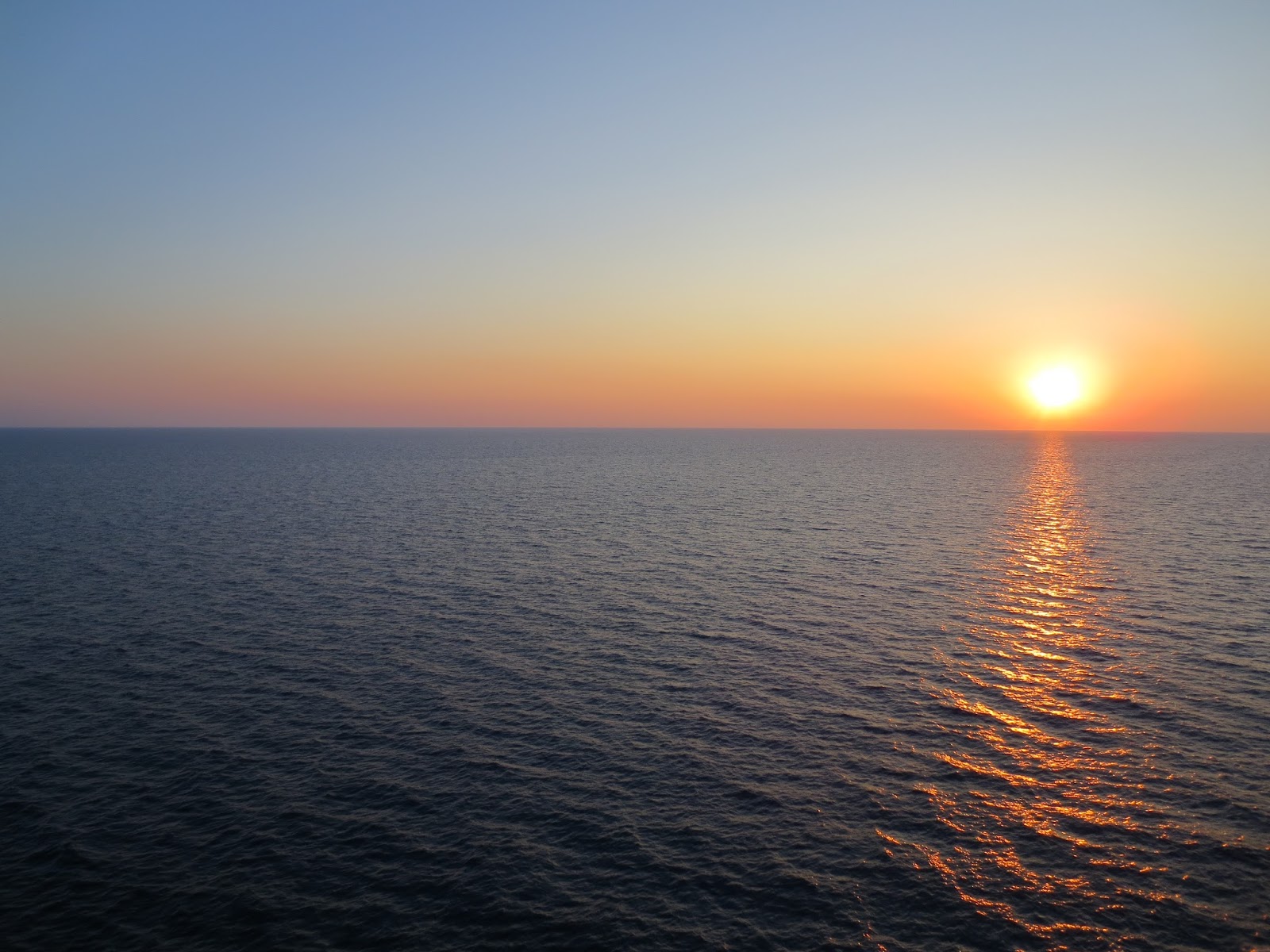
Sitting on our balcony and enjoying all the scenery was certainly one of my favorite things to do during our down time.
Not sure what was going on with my hand...I think I was mid sneeze, but not sure. It is the only picture of me doing what I found so relaxing...so here it is...as unattractive as it might be. :-)
Okay...back on track...our guide on this excursion was, well, odd to say the least, but he was FULL of information. By this I mean he literally talked the ENTIRE trip...4+ hours of him talking and NEVER stopping. He did have some good pieces of info, but after while, holy cow, you just sort of naturally tuned him out. He did have some interesting Greek Mythology background for the island of Crete. I think ever since high school English class, where we read many books on Greek Mythology, it is always fun to here more up close and personal backgrounds regarding this. So here it goes.
In a cave in Crete, it is said, the goddess Rhea hid the newborn Zeus. In that cave, Zeus was brought up by the nymphs while the demonical Kouretes would strike their shields loudly so that Cronus may not hear the crying baby of Zeus and eat it. It was also to Crete that Zeus, disguised as a bull, took Europa (a Phoenician princess) so that they may enjoy their love together. Their union produced a son, Minos, who ruled Crete and turned it into a mighty island empire of the seas.
We left the port city of Chania to visit two little villages and then we were headed back the Chania for some shopping. I don't even know the names of the villages we stopped, but they were so cute. What I quickly became aware of on this particular island in Greece is just how self sustaining they are. The soil on this island is so fertile that they can grow just about anything. It was amazing to me to see just how fruitful, literally, they were. We saw, of course, olive trees, but also pomegranate trees, fig trees, grapevines and so much more. It was incredible.
We got about 45 minutes in the first village. We just strolled around and took in the beauty. If I ever come back to Greece I would much rather spend my time in a cute little village than in one of the bigger cities. It seemed so calm, quiet and heavenly and I could have spent hours just enjoying all those traits.
After our time was up we got back on the bus and drove to another quaint little town. This one was a touch more busy and was on the water. Our guide mentioned that whenever he came to this town his mother always sent him to buy bread from her favorite bakery...so naturally I tagged along with him to get me some bread.
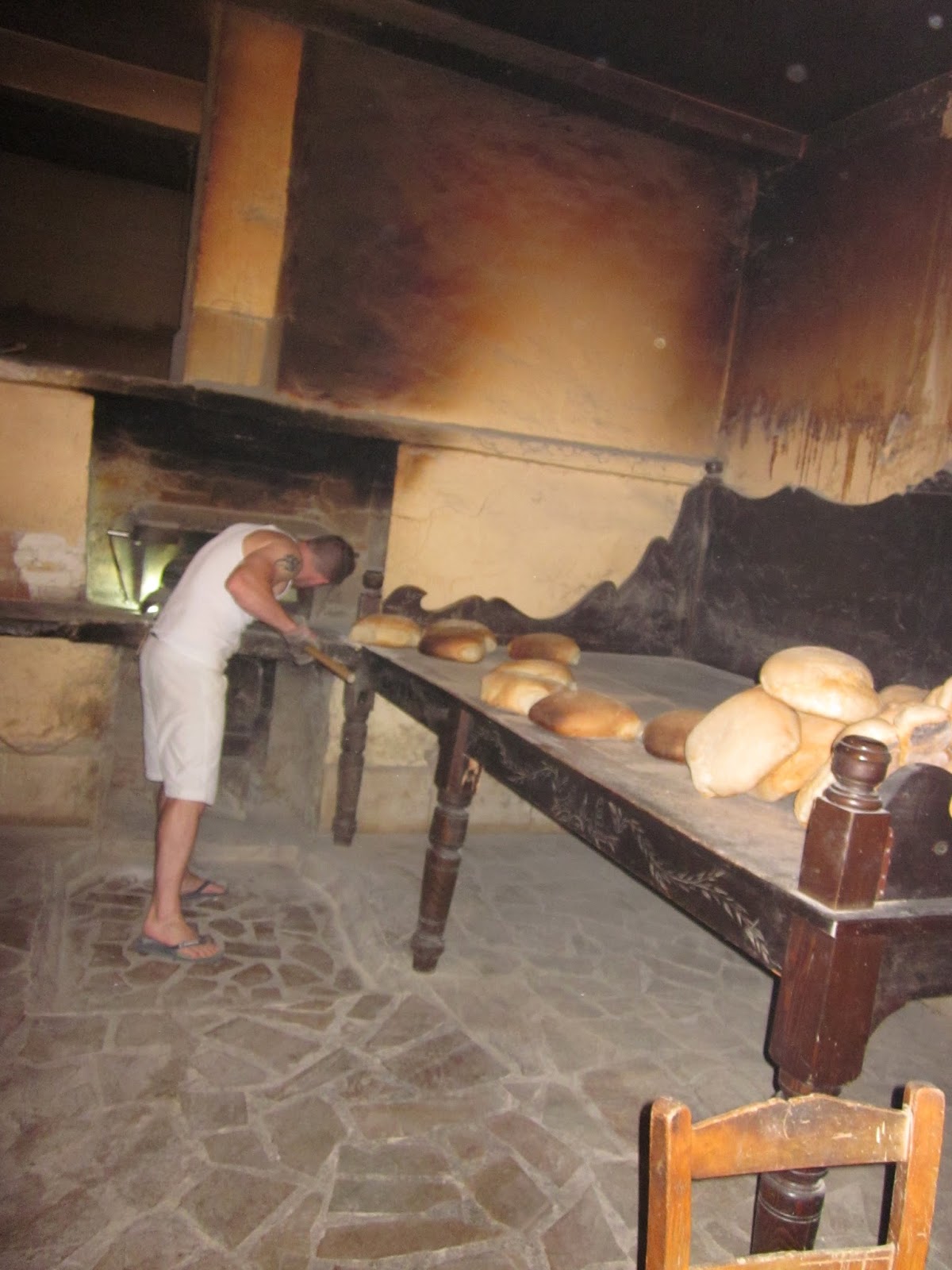
Are you freakin kidding me...this place was so cute. This guy was slaving away around this hot oven moving bread in and out and all around. That pole was super long and we almost got hit with it a couple of times. Our guide just walked over to all those loaves and picked through until he found what he wanted and paid his 1,30 euro and was on his way. I just followed in his footsteps and did the same. I couldn't believe you could manhandle all the loaves, but when in Rome...or Greece...! I also might add, it was some of the most amazing bread we had ever had, and still warm. So fun.
Again, we had a little time here, but not enough to really enjoy it. And, again, I have no idea what the village is called...you see, this is why I need Rick Steves to guide me. :-) But, here are some of the photos of this cute little village.
We boarded the bus once again and headed to one of the fortresses located on the island of Crete. After a little googling I did find some info on this location. We went to the ancient city of Aptera. Aptera is located above the entrance to the great harbor of Souda.
It is believed that Aptera was founded somewhere around the 7th century B.C. The town was abandoned after a major earthquake in the 7th century A.D., and was completely destroyed by the Arabs in A.D. 823. Again, due to time constraints we only had about 15 minutes here.
Our final destination on this excursion was the bustling port city of Chania, pronounced (Hanya), it is the second largest city of Crete. Honestly, I was unimpressed. It was busy, dirty and there were beggars everywhere. The beggars were not what you would expect. These beggars were none like I have ever seen. They were women with their small children (many actually with baby attached to breast, not nursing, just to make it look more pathetic) sitting in shady spots on the sidewalks. I found it disgusting. The public restrooms were just as disgusting. Literally, a hole in the ground with a door around it. Um...no thank you. The market that our guide took us to was definitely the location that every tourist bus dropped their load of tourists. It also appeared that no matter which tour you decided to do, you ended up here as the last stop. There were probably 40 buses in the bus parking lot waiting. Because of all the people, and remember, it was Hot as Hades, I was DONE! We strolled through the market looking for our souvenir and then just sat near a park until it was time to get back on the bus. Certainly not my favorite stop, but it is what it is. I didn't realize it at the time, but as I was getting ready to create a photo collage, I didn't take ANY pictures of Chania. This just further proves how unimpressed I was. :-(
I know this wasn't as exciting as our other days, but it was nice to get back on the boat and enjoy what the boat had to offer. The downfall of this location was that we had an earlier "back on board" time of 2:30 and it seemed that EVERY passenger arrived at the dock at the same time. It was the first time in all of our cruising ports that we had to wait to get back on...in the heat. :-)
After Chania we had a day at sea before arriving back in our starting point of Rome. We will continue our Hot as Hades tour with our excursion off the ship to Rome: the Vatican City, St. Peter's, Roman Forum, and the Colosseum and by far one of the hottest days I can recall.
As you are well aware by now, I am an avid Rick Steves fan and I love, love all of his travel books. Unfortunately, in his book Rick Steves' Mediterranean Cruise Ports he doesn't cover Chania, so I was going into this location completely blind with no direction and no idea what there was to see. When we booked our excursions through Royal Caribbean we did a package. It included an excursion for each location lumped into one deal, saving a little bit of money. The excursion for Crete was called Real Crete and I have to say I was a bit unimpressed. In hindsight, this would have been the location for the kids to stay on the boat for the day and take part in their beloved Adventure Ocean.
First, let me give you a little background on Crete. I, honestly, had not heard of this Island of Greece before the cruise. Greece has 6,000 islands scattered in the Aegean and Ionian Seas, of which only 227 of those islands are inhabited. Crete is the largest island in Greece, and the fifth largest one in the Mediterranean Sea. During the cruise we saw many islands along the way. They were just beautiful.
Sitting on our balcony and enjoying all the scenery was certainly one of my favorite things to do during our down time.
Not sure what was going on with my hand...I think I was mid sneeze, but not sure. It is the only picture of me doing what I found so relaxing...so here it is...as unattractive as it might be. :-)
Okay...back on track...our guide on this excursion was, well, odd to say the least, but he was FULL of information. By this I mean he literally talked the ENTIRE trip...4+ hours of him talking and NEVER stopping. He did have some good pieces of info, but after while, holy cow, you just sort of naturally tuned him out. He did have some interesting Greek Mythology background for the island of Crete. I think ever since high school English class, where we read many books on Greek Mythology, it is always fun to here more up close and personal backgrounds regarding this. So here it goes.
In a cave in Crete, it is said, the goddess Rhea hid the newborn Zeus. In that cave, Zeus was brought up by the nymphs while the demonical Kouretes would strike their shields loudly so that Cronus may not hear the crying baby of Zeus and eat it. It was also to Crete that Zeus, disguised as a bull, took Europa (a Phoenician princess) so that they may enjoy their love together. Their union produced a son, Minos, who ruled Crete and turned it into a mighty island empire of the seas.
We left the port city of Chania to visit two little villages and then we were headed back the Chania for some shopping. I don't even know the names of the villages we stopped, but they were so cute. What I quickly became aware of on this particular island in Greece is just how self sustaining they are. The soil on this island is so fertile that they can grow just about anything. It was amazing to me to see just how fruitful, literally, they were. We saw, of course, olive trees, but also pomegranate trees, fig trees, grapevines and so much more. It was incredible.
We got about 45 minutes in the first village. We just strolled around and took in the beauty. If I ever come back to Greece I would much rather spend my time in a cute little village than in one of the bigger cities. It seemed so calm, quiet and heavenly and I could have spent hours just enjoying all those traits.
After our time was up we got back on the bus and drove to another quaint little town. This one was a touch more busy and was on the water. Our guide mentioned that whenever he came to this town his mother always sent him to buy bread from her favorite bakery...so naturally I tagged along with him to get me some bread.
Are you freakin kidding me...this place was so cute. This guy was slaving away around this hot oven moving bread in and out and all around. That pole was super long and we almost got hit with it a couple of times. Our guide just walked over to all those loaves and picked through until he found what he wanted and paid his 1,30 euro and was on his way. I just followed in his footsteps and did the same. I couldn't believe you could manhandle all the loaves, but when in Rome...or Greece...! I also might add, it was some of the most amazing bread we had ever had, and still warm. So fun.
Again, we had a little time here, but not enough to really enjoy it. And, again, I have no idea what the village is called...you see, this is why I need Rick Steves to guide me. :-) But, here are some of the photos of this cute little village.
We boarded the bus once again and headed to one of the fortresses located on the island of Crete. After a little googling I did find some info on this location. We went to the ancient city of Aptera. Aptera is located above the entrance to the great harbor of Souda.
It is believed that Aptera was founded somewhere around the 7th century B.C. The town was abandoned after a major earthquake in the 7th century A.D., and was completely destroyed by the Arabs in A.D. 823. Again, due to time constraints we only had about 15 minutes here.
Our final destination on this excursion was the bustling port city of Chania, pronounced (Hanya), it is the second largest city of Crete. Honestly, I was unimpressed. It was busy, dirty and there were beggars everywhere. The beggars were not what you would expect. These beggars were none like I have ever seen. They were women with their small children (many actually with baby attached to breast, not nursing, just to make it look more pathetic) sitting in shady spots on the sidewalks. I found it disgusting. The public restrooms were just as disgusting. Literally, a hole in the ground with a door around it. Um...no thank you. The market that our guide took us to was definitely the location that every tourist bus dropped their load of tourists. It also appeared that no matter which tour you decided to do, you ended up here as the last stop. There were probably 40 buses in the bus parking lot waiting. Because of all the people, and remember, it was Hot as Hades, I was DONE! We strolled through the market looking for our souvenir and then just sat near a park until it was time to get back on the bus. Certainly not my favorite stop, but it is what it is. I didn't realize it at the time, but as I was getting ready to create a photo collage, I didn't take ANY pictures of Chania. This just further proves how unimpressed I was. :-(
I know this wasn't as exciting as our other days, but it was nice to get back on the boat and enjoy what the boat had to offer. The downfall of this location was that we had an earlier "back on board" time of 2:30 and it seemed that EVERY passenger arrived at the dock at the same time. It was the first time in all of our cruising ports that we had to wait to get back on...in the heat. :-)
After Chania we had a day at sea before arriving back in our starting point of Rome. We will continue our Hot as Hades tour with our excursion off the ship to Rome: the Vatican City, St. Peter's, Roman Forum, and the Colosseum and by far one of the hottest days I can recall.
Thursday, August 8, 2013
Hot as Hades Tour Port 3: Part 2 Ephesus
"Ephesus - one of the most important cities of the Roman Empire - is among the world's best ancient sites." This is how Rick Steves begins his chapter on Ephesus in his book Rick Steves' Mediterranean Cruise Ports and he wasn't kidding. This place was INCREDIBLE. We thought the Acropolis was impressive.
I am going to give you the background that Rick Steves gives in his book mentioned above because he really does a beautiful job in telling the story.
"At its peak in the first and second centuries A.D., Ephesus was one of the grandest cities of the ancient world, ranking among the four leading centers of the Roman Empire (along with Alexandria, Antioch, and Rome itself). With a staggering quarter of a million residents, Ephesus was the second-biggest city in the empire (after Rome). The Ephesus we see today reflects the many civilizations--Greek, Persian, Roman, and Christian--that passed through Asia Minor (today's Turkey) in the days before the Ottomans. Julius Caesar, Anthony and Cleopatra, St. Paul, and possibly St. John and even the Virgin Mary have all walked these same marble roads.
The area was first settled around 1000 B.C. According to legend, the Oracle of Delphi prophesied that the Greek prince Androklos would found a city at a place revealed to him by "a wild boar and fish." Androklos set sail to the west, and eventually found his way to the beach where the Cayster (a.k.a. Meander) River met the Aegean Sea. While Androklos grilled his dinner at a campfire, a fish fell into the fire, knocked some embers into a bush, and ignited it---flushing out a boar. Androklos tracked the boar into the valley where he would found Ephesus.
The city grew as a seaport and the worship center of the goddess Artemis. By 500 B.C., it was a bustling cultural capital on the Mediterranean. It sported the enormous Temple of Artemis, famous in its day and now in ruins.
Ephesus was part of the sophisticated Ionian world of western Asia Minor that inspired the rise of Golden Age Greece across the pond. The Ephesians spoke Greek (but with an Ionian dialect), produced "Greek" philosophers such as Heraclitus (who said the only constant is change), and popularized the style of Greek columns called Ionic (topped with scroll-like capitals). From time to time over the centuries, more warlike people--Lydians, Persians, Athenians, Alexander the Great, and Romans--overran Ephesus, but everyday life went on unchanged in this cosmopolitan city.
Oddly, the physical location of ancient Ephesus has moved over time. The sandy composition of the valley's soil and the constant movement of alluvial sands have made this an ever-changing landscape. The Meander River (whose circuitous course gave us the word) had a tendency to shift its path over time. When the river's access to the sea silted up in the third century B.C., the Ephesians relocated their city to the valley where the ruins now sit.
It was under Roman rule that Ephesus reached its peak. In A.D. 27, Emperor Augustus made the city the capital of the Roman province of Asia (roughly corresponding to today's Turkish west coast). The harbor at Ephesus bustled with trade (including the slave trade) throughout the vast Roman Empire. By A.D. 100, it had become a city of marble buildings and grand monuments, with an infrastructure that could support hundreds of thousands of toga-ed citizens. The ruins you'll see today date largely from the city's Roman heyday in those first two centuries after Christ.
Ephesus' prominence attracted some of the earliest followers of Christ. St. Paul came to Ephesus (about A.D. 52), where he conducted missionary work and wrote his First Epistle to the Corinthians ("Love is patient, love is kind. It does not envy, it does not boast, it is not proud"). St. John also may have come to Ephesus (about A.D. 90), having been charged with spreading Christianity in the Roman province of Asia. And even the Virgin Mary supposedly retired to Ephesus (brought by John).
As the Roman Empire fell, so fell Ephesus. In A.D. 263, invading barbarians looted the city, and it never really recovered. Ephesus limped along under the wing of the Byzantine Empire--the Christian empire ruled from Constantinople (today's Istanbul). By the seventh century A.D., that same old problem--silting up of the harbor inlet--finally closed Ephesus' port for good. The city was relocated once again, this time to the area around today's town of Selcuk. The marshy ground bred mosquito-borne malaria that decimated the population. The impressive buildings were scavenged for their conveniently pre-cut stones. Earthquakes further leveled the monuments. Buried over the centuries, Ephesus was forgotten until the 1860s, when a series of British, German, and Austrian archaeologists rediscovered and excavated the site (many of its treasures are now on display in Vienna's Ephesus Museum, and others are in the British Museum in London). Although only 15 percent of the site has been unearthed, it is still one of the largest excavated areas in the world."
Phewf...I hate to copy word for word, but I really love how he describes things in an interesting way. I always read up on the locations we are about to visit so that I can take it all in with a little more knowledge and direction. After reading the background and walking on the incredibly preserved "boulevard" and to think that the people mentioned above have walked the same path. WOW!!!!!!!!
As I mentioned in a previous post our guide was great, but there really is only so much information you can take in at one time. You could probably spend hours and hours here (except not in July or August) and still not really absorb all it has to offer. We were there, maybe, 2 hours...if that, and it was overwhelming. It was overwhelming partly because we had to just keep moving to keep up with our guide and as he was talking we were trying to see everything around us and let us not forget...it was Hot as Hades. As you can see from the picture above there is absolutely no shade whatsoever. The sun just beats down on you for the whole tour. We had to be in long/longer pants because no knees or shoulders were allowed to be exposed in the House of Virgin Mary, though unfortunately that was not enforced. I found it a bit disrespectful, but who am I to turn people away.
So now take a walk with me through ancient Ephesus...
As you arrive in Ephesus you begin with smaller ruins, not unimpressive, but nothing that compared to what was to come (though we didn't know that yet...so we were impressed). This area was the upper gate area and little is left today of what is said to be an open-aired courtyard. A place where shoppers could escape the elements, rain and sun (though there was no escape left for us-haha), catch up with their neighbors, and talk politics. In this area we saw the remains of ancient plumbing.
Turning around from this site of ancient plumbing was the area that would have been the market.
Just behind this market was the Odeon...remember this word. I love it when things make a reappearance and a theme is born. Remember, from the Acropolis, there was the Odeon of Herodes Atticus, where musical, not theatrical, performances were held. This Odeon dates from around A.D. 15. It was an indoor theater--once topped with a wooden roof--that seated 1,500. This was a more intimate venue. Some of the lower marble seats are original, but the upper seats were restored in the 1950s. Due to the quick pace of our guide we didn't get to get up close and explore this area, but Rick Steves states that among the original lower marble seats the elegant lion-feet armrests still survive. He also says that to get a sense of how deeply this site was excavated, the theater was once buried up to its tops seats.
Next we headed to what would have been a sort of town hall. It was here where a committee would make decisions about city administration.
Now we are headed down what is known as Sacred Way. The short road leads downhill from the upper gate to Domitian Square.
Even thousands of years ago people needed directions. Along the Sacred Way are two stone pillars with carved directional markers. One, facing the market, is a statue of Hermes (god of merchants); the other, facing a pharmacy, is Asklepios (symbolizing medicine).
Just past these stones we entered Domitian Square. The square was surrounded by important buildings and monuments. The highest surviving arch (below) marks what was a public water fountain.
The centerpiece of the square was the Temple of Domition, dedicated to the notorious first century A.D. Roman emperor. Though little remains today, the temple was large. A bit of the temple facade still stands. You can see below, where the two statues are atop a couple of columns. Domition was the cruel, lunatic emperor who, it is believed, sent John the Prophet into exile to the nearby island of Patmos, where he worked in a rock quarry and wrote the Book of Revelation.
Keepin on truckin...we pass through Hercules Gate. This gate was intentionally too narrow to let chariots pass---marking the transition from pedestrian-only upper Ephesus to the commercial section. Who doesn't love a pedestrian-only zone...especially in Europe (haha).
I am going to give you the background that Rick Steves gives in his book mentioned above because he really does a beautiful job in telling the story.
"At its peak in the first and second centuries A.D., Ephesus was one of the grandest cities of the ancient world, ranking among the four leading centers of the Roman Empire (along with Alexandria, Antioch, and Rome itself). With a staggering quarter of a million residents, Ephesus was the second-biggest city in the empire (after Rome). The Ephesus we see today reflects the many civilizations--Greek, Persian, Roman, and Christian--that passed through Asia Minor (today's Turkey) in the days before the Ottomans. Julius Caesar, Anthony and Cleopatra, St. Paul, and possibly St. John and even the Virgin Mary have all walked these same marble roads.
The area was first settled around 1000 B.C. According to legend, the Oracle of Delphi prophesied that the Greek prince Androklos would found a city at a place revealed to him by "a wild boar and fish." Androklos set sail to the west, and eventually found his way to the beach where the Cayster (a.k.a. Meander) River met the Aegean Sea. While Androklos grilled his dinner at a campfire, a fish fell into the fire, knocked some embers into a bush, and ignited it---flushing out a boar. Androklos tracked the boar into the valley where he would found Ephesus.
The city grew as a seaport and the worship center of the goddess Artemis. By 500 B.C., it was a bustling cultural capital on the Mediterranean. It sported the enormous Temple of Artemis, famous in its day and now in ruins.
Ephesus was part of the sophisticated Ionian world of western Asia Minor that inspired the rise of Golden Age Greece across the pond. The Ephesians spoke Greek (but with an Ionian dialect), produced "Greek" philosophers such as Heraclitus (who said the only constant is change), and popularized the style of Greek columns called Ionic (topped with scroll-like capitals). From time to time over the centuries, more warlike people--Lydians, Persians, Athenians, Alexander the Great, and Romans--overran Ephesus, but everyday life went on unchanged in this cosmopolitan city.
Oddly, the physical location of ancient Ephesus has moved over time. The sandy composition of the valley's soil and the constant movement of alluvial sands have made this an ever-changing landscape. The Meander River (whose circuitous course gave us the word) had a tendency to shift its path over time. When the river's access to the sea silted up in the third century B.C., the Ephesians relocated their city to the valley where the ruins now sit.
It was under Roman rule that Ephesus reached its peak. In A.D. 27, Emperor Augustus made the city the capital of the Roman province of Asia (roughly corresponding to today's Turkish west coast). The harbor at Ephesus bustled with trade (including the slave trade) throughout the vast Roman Empire. By A.D. 100, it had become a city of marble buildings and grand monuments, with an infrastructure that could support hundreds of thousands of toga-ed citizens. The ruins you'll see today date largely from the city's Roman heyday in those first two centuries after Christ.
Ephesus' prominence attracted some of the earliest followers of Christ. St. Paul came to Ephesus (about A.D. 52), where he conducted missionary work and wrote his First Epistle to the Corinthians ("Love is patient, love is kind. It does not envy, it does not boast, it is not proud"). St. John also may have come to Ephesus (about A.D. 90), having been charged with spreading Christianity in the Roman province of Asia. And even the Virgin Mary supposedly retired to Ephesus (brought by John).
As the Roman Empire fell, so fell Ephesus. In A.D. 263, invading barbarians looted the city, and it never really recovered. Ephesus limped along under the wing of the Byzantine Empire--the Christian empire ruled from Constantinople (today's Istanbul). By the seventh century A.D., that same old problem--silting up of the harbor inlet--finally closed Ephesus' port for good. The city was relocated once again, this time to the area around today's town of Selcuk. The marshy ground bred mosquito-borne malaria that decimated the population. The impressive buildings were scavenged for their conveniently pre-cut stones. Earthquakes further leveled the monuments. Buried over the centuries, Ephesus was forgotten until the 1860s, when a series of British, German, and Austrian archaeologists rediscovered and excavated the site (many of its treasures are now on display in Vienna's Ephesus Museum, and others are in the British Museum in London). Although only 15 percent of the site has been unearthed, it is still one of the largest excavated areas in the world."
Phewf...I hate to copy word for word, but I really love how he describes things in an interesting way. I always read up on the locations we are about to visit so that I can take it all in with a little more knowledge and direction. After reading the background and walking on the incredibly preserved "boulevard" and to think that the people mentioned above have walked the same path. WOW!!!!!!!!
As I mentioned in a previous post our guide was great, but there really is only so much information you can take in at one time. You could probably spend hours and hours here (except not in July or August) and still not really absorb all it has to offer. We were there, maybe, 2 hours...if that, and it was overwhelming. It was overwhelming partly because we had to just keep moving to keep up with our guide and as he was talking we were trying to see everything around us and let us not forget...it was Hot as Hades. As you can see from the picture above there is absolutely no shade whatsoever. The sun just beats down on you for the whole tour. We had to be in long/longer pants because no knees or shoulders were allowed to be exposed in the House of Virgin Mary, though unfortunately that was not enforced. I found it a bit disrespectful, but who am I to turn people away.
So now take a walk with me through ancient Ephesus...
As you arrive in Ephesus you begin with smaller ruins, not unimpressive, but nothing that compared to what was to come (though we didn't know that yet...so we were impressed). This area was the upper gate area and little is left today of what is said to be an open-aired courtyard. A place where shoppers could escape the elements, rain and sun (though there was no escape left for us-haha), catch up with their neighbors, and talk politics. In this area we saw the remains of ancient plumbing.
Turning around from this site of ancient plumbing was the area that would have been the market.
Just behind this market was the Odeon...remember this word. I love it when things make a reappearance and a theme is born. Remember, from the Acropolis, there was the Odeon of Herodes Atticus, where musical, not theatrical, performances were held. This Odeon dates from around A.D. 15. It was an indoor theater--once topped with a wooden roof--that seated 1,500. This was a more intimate venue. Some of the lower marble seats are original, but the upper seats were restored in the 1950s. Due to the quick pace of our guide we didn't get to get up close and explore this area, but Rick Steves states that among the original lower marble seats the elegant lion-feet armrests still survive. He also says that to get a sense of how deeply this site was excavated, the theater was once buried up to its tops seats.
Next we headed to what would have been a sort of town hall. It was here where a committee would make decisions about city administration.
Now we are headed down what is known as Sacred Way. The short road leads downhill from the upper gate to Domitian Square.
Even thousands of years ago people needed directions. Along the Sacred Way are two stone pillars with carved directional markers. One, facing the market, is a statue of Hermes (god of merchants); the other, facing a pharmacy, is Asklepios (symbolizing medicine).
Just past these stones we entered Domitian Square. The square was surrounded by important buildings and monuments. The highest surviving arch (below) marks what was a public water fountain.
The centerpiece of the square was the Temple of Domition, dedicated to the notorious first century A.D. Roman emperor. Though little remains today, the temple was large. A bit of the temple facade still stands. You can see below, where the two statues are atop a couple of columns. Domition was the cruel, lunatic emperor who, it is believed, sent John the Prophet into exile to the nearby island of Patmos, where he worked in a rock quarry and wrote the Book of Revelation.
Keepin on truckin...we pass through Hercules Gate. This gate was intentionally too narrow to let chariots pass---marking the transition from pedestrian-only upper Ephesus to the commercial section. Who doesn't love a pedestrian-only zone...especially in Europe (haha).
After passing through Hercules Gate we were standing on Curetes Road, which was the beginning of the commercial zone. This road gives you a small glimpse of the epic scale of Ephesus at its peak. Rick Steves aks us to mentally replace the tourists with toga-clad ancients in order to imagine the Roman metropolis in its heyday. A place with statues, bubbling fountains, arches, and shops lining the streets. Columns supported a covered walkway for pedestrians, while chariots, wagons, and men on horseback traveled the road. Where there would be buildings on either side of the street with shops below and homes above.
As we walked down Curetes Road we came upon Trajan's Fountain on our right. This was a public fountain. During those times the wealthy had indoor plumbing and fountains like this were for everyone else. You can see the remnants of an orb. Beneath the arch of the fountain once stood a statue of Emperor Trajan with his foot on this orb and a phrase "Trajan ruled the world with his right foot". This provides clear evidence that ancient Romans assumed the world was round. You can also see two holes on the lower part of the fountain. It is said that the Ephesians would just uncork the fountain to cool and clean their town.
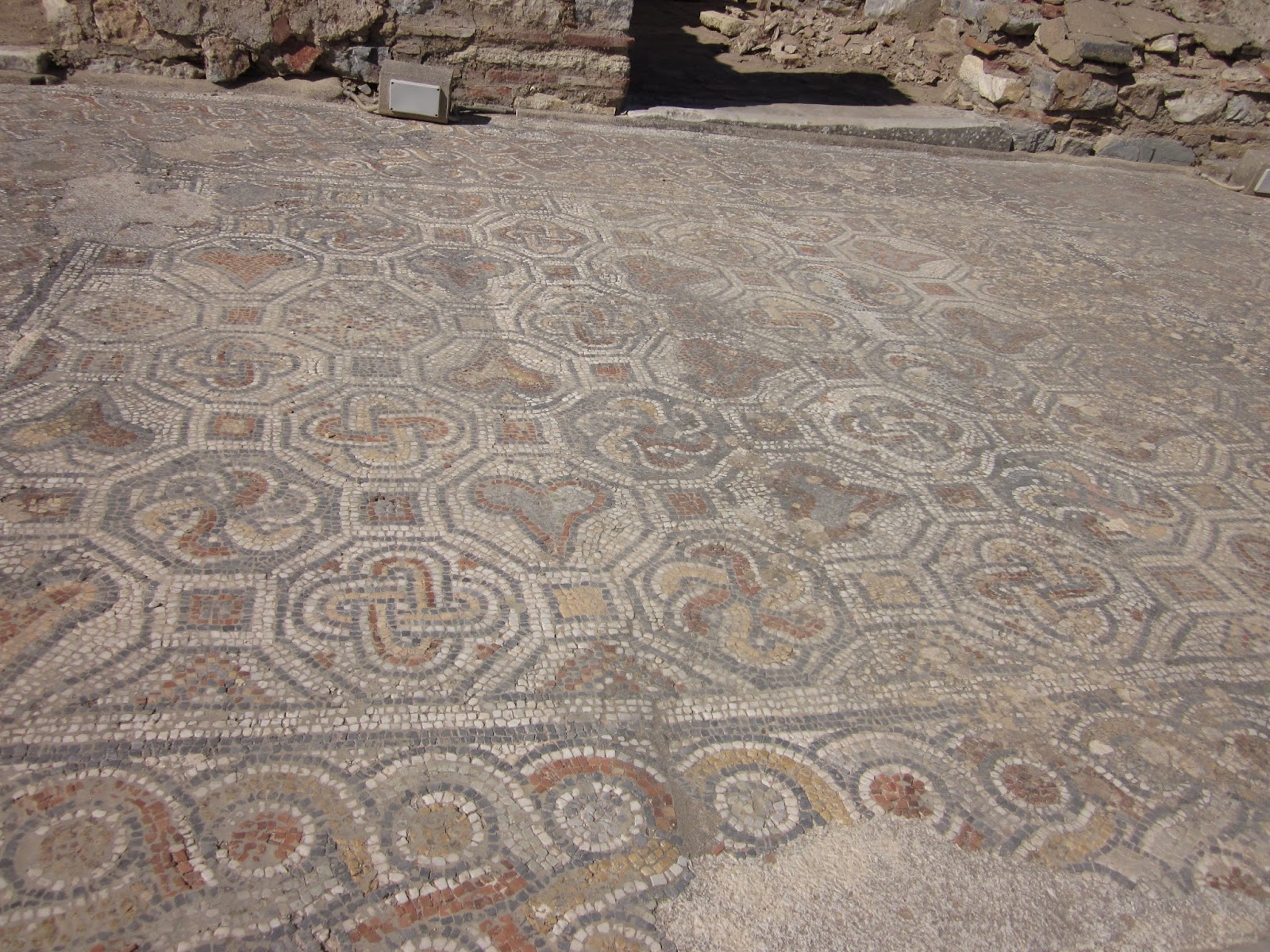
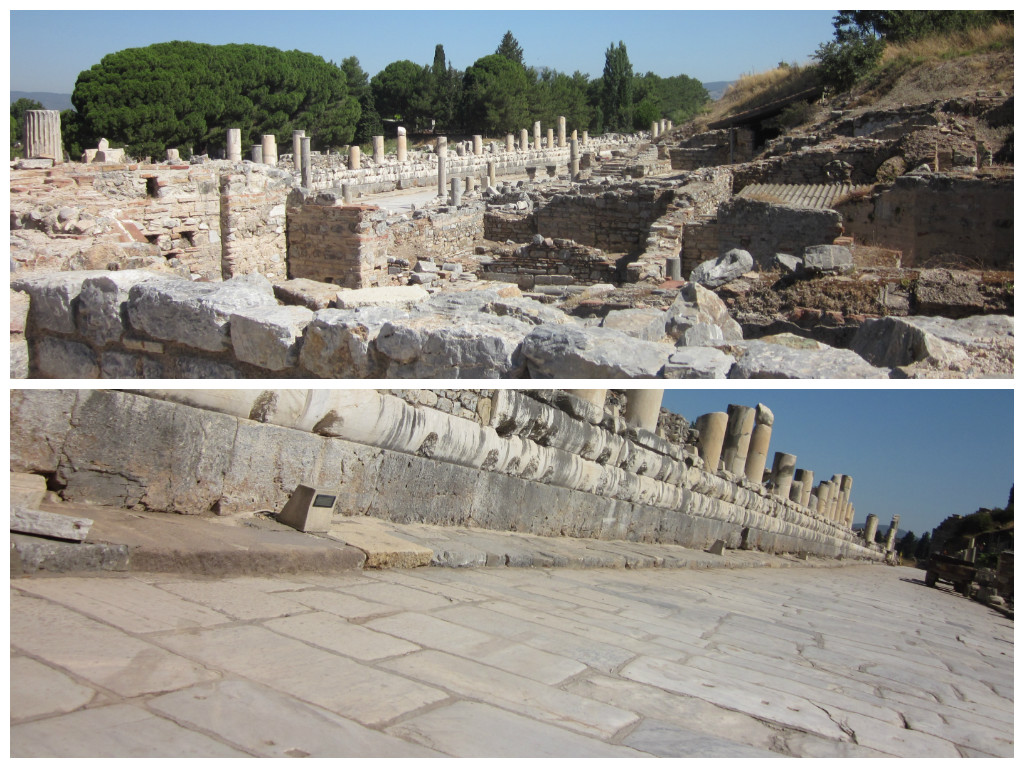
Crossing the street from Trajan's Fountain you can't help but notice the most incredible mosaic sidewalk. Imagine the shops that would have lined this area...possibly a place for Louis Vuitton, Chanel, or Dior of the Roman Times.
Along these sidewalks is also where the Roman baths were located...sort of an early day "spa". Roman baths tend to be divided into rooms with special purposes: changing cooling-off, warming, hot steam and so on. We have noticed in many of the locations we have traveled, with any Roman background, there are almost always Roman baths. They do still have some in use today in many of the Mediterranean lands.
After popping back on the main street we come upon the Temple of Hadrian. The structure has incredible carvings. I didn't get a picture straight on. I will only explain the carvings that you can see in my picture. You can see carvings of what appear to be eggs and little flowers--these are symbols of fertility.
Well at this point we have walked quite a bit and drank lots and lots of water...so naturally...who isn't ready for some public toilets. Not many Ephesians could afford private bathrooms, so public toilets it was. Oh yes! Can you imagine a public restroom where you did your business with 39 of your closest friends while talking shop. The seating was made out of marble (I can only imagine how cold that might get come December) and this open-aired courtyard once did have a wooden roof. There was a constant stream of water that would "flush" away the waste and then a second stream of clean water for washing. Yikes...no thank you. I also remember our guide saying these were for men only, but can't remember 100%.
As we left the restroom we could see a little road that leads to the right of the main road. This road is only open to visitors on the weekends and was once the road to another "Odeon" or theater and the harbor. The road is made of marble and little survives along this road now.
At the end of the main road stands one of the iconic Roman-ruin images in the world, the Library of Celsus. This structure was incredible. It was the third largest library of the ancient world (behind Alexandria and Pergamon), with upwards of 12,000 volumes. Its namesake, Celsus, was a well-read governor of this province, whose son built the library as a mausoleum in his honor in A.D. 123. The library was restored to what we see today in the 1970s.
With the help of Rick Steves I will describe what you are seeing. The library's facade --two monumental stories tall--features a distinctive grid of columns and recessed niches. Those Corinthian columns (topped with leafy capitals) on the ground floor are 40 feet tall. There were three grand doorways, each matched by windows above. The four statues in the niches represent the traits of Celsus: wisdom, knowledge, intelligence, and valor.
Step inside the small interior, and picture it in it's prime. The walls and floors were once gleaming marble (which covered the restored brick understructure we see today). Light poured in through the big east-facing windows. The niches inside once housed scrolls.
Leaving the Library through a triple arched gate led us into the large marketplace of Ephesus. Similar to our modern day supermarket and shopping mall.
The last sight to see was at the end of our journey...a certain relief for two extremely overheated kids...was the Great Theater. Again, due to time restrictions we didn't get to explore this site at all, but from our vantage point there was no doubt that this theater was HUGE!!!!! This theater held 25,000 spectators and is possibly the largest anywhere. It is said that a Roman theater was typically built to accommodate 10% of its city's population, experts guess that ancient Ephesus had 250,000 residents. The ancient Greeks built the theater in the third century B.C. When the Romans came, they enlarged and modified it for their type of entertainment. The Romans used the theater not only for musical performances (the acoustics are still phenomenal today), but also for gladiator fights.
A quick side note...notice all the pieces laid out behind Chad and I...well these are identified and awaiting reconstruction.
I'll leave you with another excerpt from Rick Steves' book mentioned above about a role this theater played in history.
"This theater played a role in the dramatic story of the Apostle Paul, who lived in Ephesus about A.D. 52-54, While Christianity's message that all are created equal in God's eyes resonated with "the 99 percent," it threatened and offended the society's elites. Paul also ruffled feathers by strongly denouncing the worship of false idols. Remember that the cult of the goddess Artemis was big business in Ephesus. Artemis idol-carvers didn't like Paul's interference one bit. According to the Bible (Acts 29), they stirred up an angry mob and snatched some of Paul's Christian companions. Shouting "Artemis is great," the rabble-rousers dragged the captured Christians to this theater. Paul wanted to save them, but cooler-headed colleagues held him back. Fortunately, the enraged crowd inside calmed down and spared the Christians from harm."
Thanks for strolling through Ancient Ephesus with us. Such an incredible sight. It is hard to believe there are ruins such as these all over Europe. Before we moved to Europe, I was completely oblivious to so many things about history, that it is almost embarrassing. With the rise of many current TV shows depicting life in ancient times you can just picture them in places like Ephesus. Though they lived, thousands and thousands of years ago, it doesn't appear to be much different from how we live our lives today, well minus technological advances, of course. We still need places to buy our groceries and wears. We still need places to pamper ourselves. We still need places where we can come together with our neighbors and talk about local happenings. We still need places to "borrow" a book or 12,000. We still need public restrooms, though thankfully nowadays women are allowed and there are individual stalls. We still need places to enjoy entertainment. We still need places to "stroll" and enjoy our cities. I know this was a lot to take in, but I hope now you can sit back and take a little step back in time.
Stay tuned, because tomorrow we will continue our Hot as Hades Tour at Port 4: Chania, Greece on the island of Crete.
Subscribe to:
Posts (Atom)