Thursday, August 8, 2013

Hot as Hades Tour Port 3: Part 2 Ephesus

"Ephesus - one of the most important cities of the Roman Empire - is among the world's best ancient sites." This is how Rick Steves begins his chapter on Ephesus in his book Rick Steves' Mediterranean Cruise Ports and he wasn't kidding. This place was INCREDIBLE. We thought the Acropolis was impressive.


I am going to give you the background that Rick Steves gives in his book mentioned above because he really does a beautiful job in telling the story.
   
     "At its peak in the first and second centuries A.D., Ephesus was one of the grandest cities of the ancient world, ranking among the four leading centers of the Roman Empire (along with Alexandria, Antioch, and Rome itself). With a staggering quarter of a million residents, Ephesus was the second-biggest city in the empire (after Rome). The Ephesus we see today reflects the many civilizations--Greek, Persian, Roman, and Christian--that passed through Asia Minor (today's Turkey) in the days before the Ottomans. Julius Caesar, Anthony and Cleopatra, St. Paul, and possibly St. John and even the Virgin Mary have all walked these same marble roads.
     The area was first settled around 1000 B.C. According to legend, the Oracle of Delphi prophesied that the Greek prince Androklos would found a city at a place revealed to him by "a wild boar and fish." Androklos set sail to the west, and eventually found his way to the beach where the Cayster (a.k.a. Meander) River met the Aegean Sea. While Androklos grilled his dinner at a campfire, a fish fell into the fire, knocked some embers into a bush, and ignited it---flushing out a boar. Androklos tracked the boar into the valley where he would found Ephesus.
     The city grew as a seaport and the worship center of the goddess Artemis. By 500 B.C., it was a bustling cultural capital on the Mediterranean. It sported the enormous Temple of Artemis, famous in its day and now in ruins.
     Ephesus was part of the sophisticated Ionian world of western Asia Minor that inspired the rise of Golden Age Greece across the pond. The Ephesians spoke Greek (but with an Ionian dialect), produced "Greek" philosophers such as Heraclitus (who said the only constant is change), and popularized the style of Greek columns called Ionic (topped with scroll-like capitals). From time to time over the centuries, more warlike people--Lydians, Persians, Athenians, Alexander the Great, and Romans--overran Ephesus, but everyday life went on unchanged in this cosmopolitan city.
     Oddly, the physical location of ancient Ephesus has moved over time. The sandy composition of the valley's soil and the constant movement of alluvial sands have made this an ever-changing landscape. The Meander River (whose circuitous course gave us the word) had a tendency to shift its path over time. When the river's access to the sea silted up in the third century B.C., the Ephesians relocated their city to the valley where the ruins now sit.
     It was under Roman rule that Ephesus reached its peak. In A.D. 27, Emperor Augustus made the city the capital of the Roman province of Asia (roughly corresponding to today's Turkish west coast). The harbor at Ephesus bustled with trade (including the slave trade) throughout the vast Roman Empire. By A.D. 100, it had become a city of marble buildings and grand monuments, with an infrastructure that could support hundreds of thousands of toga-ed citizens. The ruins you'll see today date largely from the city's Roman heyday in those first two centuries after Christ.
     Ephesus' prominence attracted some of the earliest followers of Christ. St. Paul came to Ephesus (about A.D. 52), where he conducted missionary work and wrote his First Epistle to the Corinthians ("Love is patient, love is kind. It does not envy, it does not boast, it is not proud"). St. John also may have come to Ephesus (about A.D. 90), having been charged with spreading Christianity in the Roman province of Asia. And even the Virgin Mary supposedly retired to Ephesus (brought by John).
     As the Roman Empire fell, so fell Ephesus. In A.D. 263, invading barbarians looted the city, and it never really recovered. Ephesus limped along under the wing of the Byzantine Empire--the Christian empire ruled from Constantinople (today's Istanbul). By the seventh century A.D., that same old problem--silting up of the harbor inlet--finally closed Ephesus' port for good. The city was relocated once again, this time to the area around today's town of Selcuk. The marshy ground bred mosquito-borne malaria that decimated the population. The impressive buildings were scavenged for their conveniently pre-cut stones. Earthquakes further leveled the monuments. Buried over the centuries, Ephesus was forgotten until the 1860s, when a series of British, German, and Austrian archaeologists rediscovered and excavated the site (many of its treasures are now on display in Vienna's Ephesus Museum, and others are in the British Museum in London). Although only 15 percent of the site has been unearthed, it is still one of the largest excavated areas in the world."

Phewf...I hate to copy word for word, but I really love how he describes things in an interesting way. I always read up on the locations we are about to visit so that I can take it all in with a little more knowledge and direction. After reading the background and walking on the incredibly preserved "boulevard" and to think that the people mentioned above have walked the same path. WOW!!!!!!!!

As I mentioned in a previous post our guide was great, but there really is only so much information you can take in at one time.  You could probably spend hours and hours here (except not in July or August) and still not really absorb all it has to offer. We were there, maybe, 2 hours...if that, and it was overwhelming. It was overwhelming partly because we had to just keep moving to keep up with our guide and as he was talking we were trying to see everything around us and let us not forget...it was Hot as Hades. As you can see from the picture above there is absolutely no shade whatsoever.  The sun just beats down on you for the whole tour. We had to be in long/longer pants because no knees or shoulders were allowed to be exposed in the House of Virgin Mary, though unfortunately that was not enforced. I found it a bit disrespectful, but who am I to turn people away.

So now take a walk with me through ancient Ephesus...

As you arrive in Ephesus you begin with smaller ruins, not unimpressive, but nothing that compared to what was to come (though we didn't know that yet...so we were impressed). This area was the upper gate area and little is left today of what is said to be an open-aired courtyard. A place where shoppers could escape the elements, rain and sun (though there was no escape left for us-haha), catch up with their neighbors, and talk politics. In this area we saw the remains of ancient plumbing.


Turning around from this site of ancient plumbing was the area that would have been the market.


Just behind this market was the Odeon...remember this word.  I love it when things make a reappearance and a theme is born. Remember, from the Acropolis, there was the Odeon of Herodes Atticus, where musical, not theatrical, performances were held. This Odeon dates from around A.D. 15. It was an indoor theater--once topped with a wooden roof--that seated 1,500. This was a more intimate venue. Some of the lower marble seats are original, but the upper seats were restored in the 1950s. Due to the quick pace of our guide we didn't get to get up close and explore this area, but Rick Steves states that among the original lower marble seats the elegant lion-feet armrests still survive. He also says that to get a sense of how deeply this site was excavated, the theater was once buried up to its tops seats.


Next we headed to what would have been a sort of town hall. It was here where a committee would make decisions about city administration.


Now we are headed down what is known as Sacred Way. The short road leads downhill from the upper gate to Domitian Square.


Even thousands of years ago people needed directions. Along the Sacred Way are two stone pillars with carved directional markers. One, facing the market, is a statue of Hermes (god of merchants); the other, facing a pharmacy, is Asklepios (symbolizing medicine).


Just past these stones we entered Domitian Square. The square was surrounded by important buildings and monuments. The highest surviving arch (below) marks what was a public water fountain.


The centerpiece of the square was the Temple of Domition, dedicated to the notorious first century A.D. Roman emperor. Though little remains today, the temple was large. A bit of the temple facade still stands. You can see below, where the two statues are atop a couple of columns. Domition was the cruel, lunatic emperor who, it is believed, sent John the Prophet into exile to the nearby island of Patmos, where he worked in a rock quarry and wrote the Book of Revelation.


Keepin on truckin...we pass through Hercules Gate. This gate was intentionally too narrow to let chariots pass---marking the transition from pedestrian-only upper Ephesus to the commercial section. Who doesn't love a pedestrian-only zone...especially in Europe (haha).


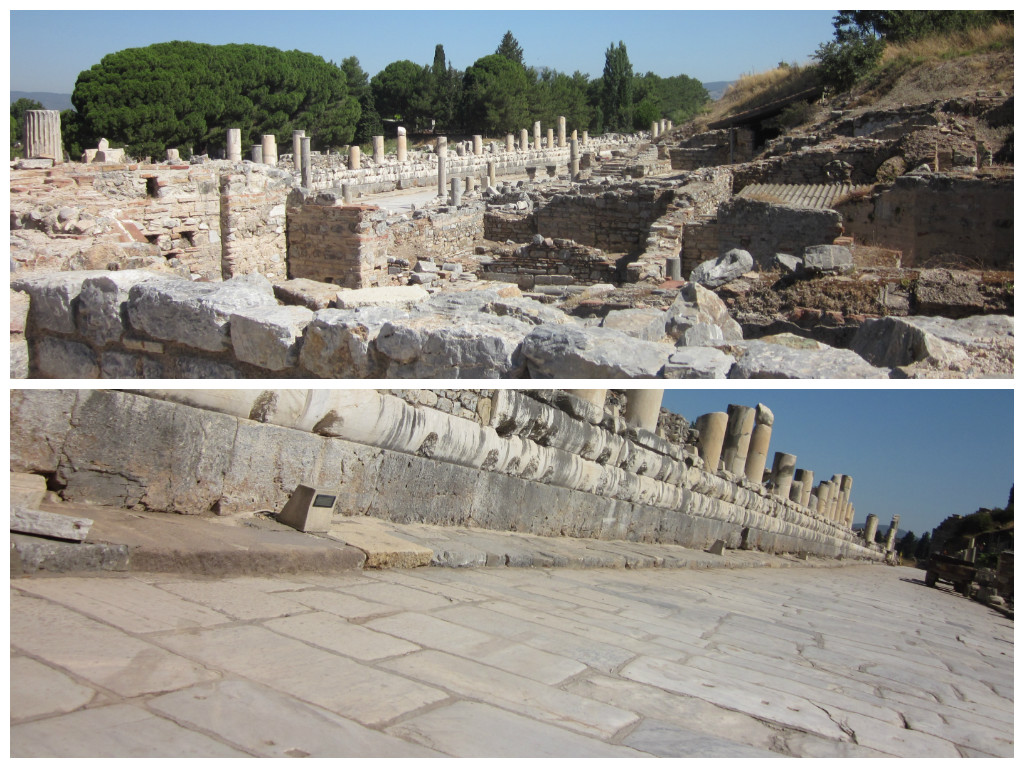
After passing through Hercules Gate we were standing on Curetes Road, which was the beginning of the commercial zone. This road gives you a small glimpse of the epic scale of Ephesus at its peak. Rick Steves aks us to mentally replace the tourists with toga-clad ancients in order to imagine the Roman metropolis in its heyday. A place with statues, bubbling fountains, arches, and shops lining the streets. Columns supported a covered walkway for pedestrians, while chariots, wagons, and men on horseback traveled the road. Where there would be buildings on either side of the street with shops below and homes above.


As we walked down Curetes Road we came upon Trajan's Fountain on our right. This was a public fountain. During those times the wealthy had indoor plumbing and fountains like this were for everyone else. You can see the remnants of an orb. Beneath the arch of the fountain once stood a statue of Emperor Trajan with his foot on this orb and a phrase "Trajan ruled the world with his right foot". This provides clear evidence that ancient Romans assumed the world was round. You can also see two holes on the lower part of the fountain. It is said that the Ephesians would just uncork the fountain to cool and clean their town.


Crossing the street from Trajan's Fountain you can't help but notice the most incredible mosaic sidewalk. Imagine the shops that would have lined this area...possibly a place for Louis Vuitton, Chanel, or Dior of the Roman Times.
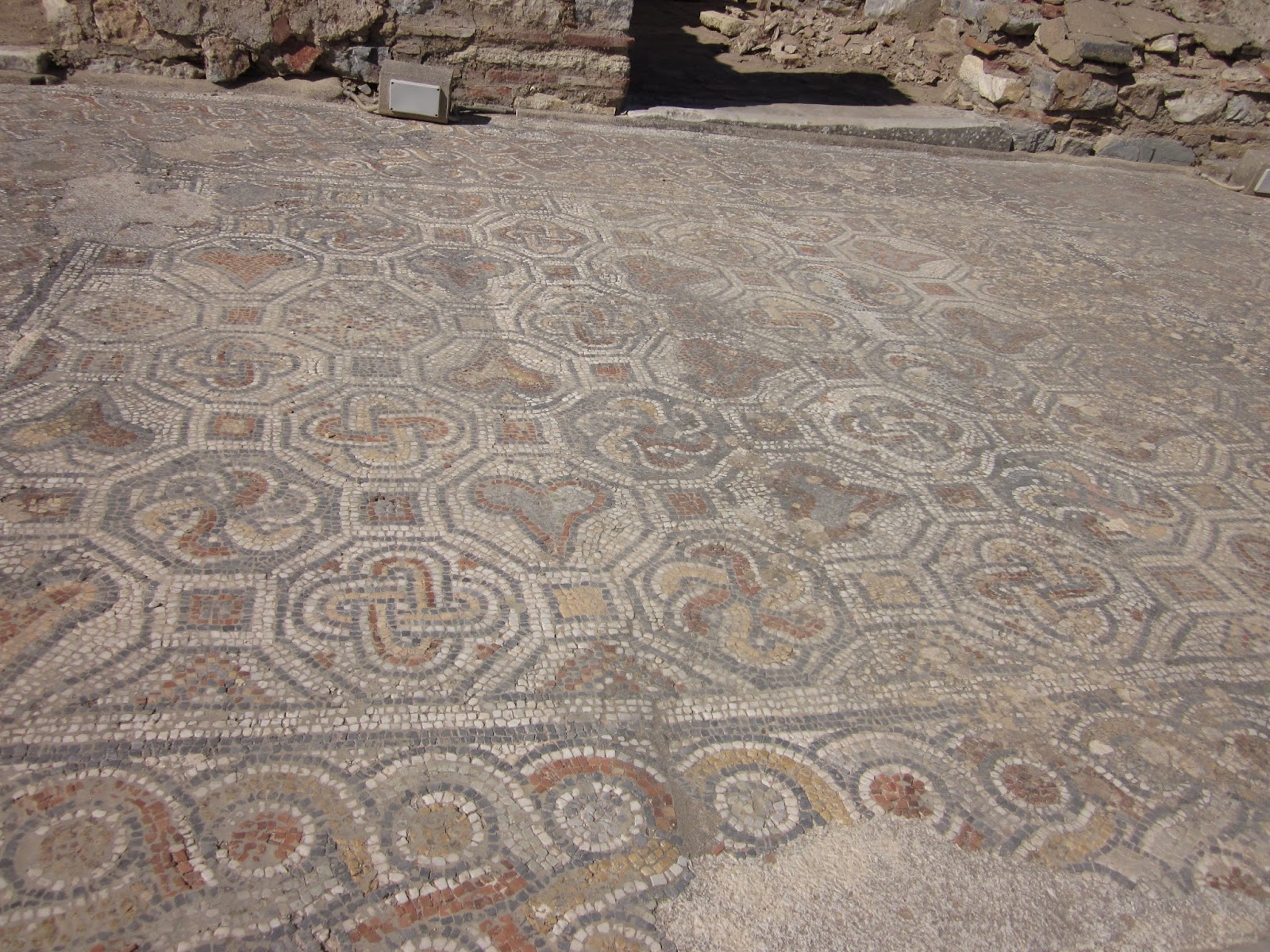

Along these sidewalks is also where the Roman baths were located...sort of an early day "spa". Roman baths tend to be divided into rooms with special purposes: changing cooling-off, warming, hot steam and so on. We have noticed in many of the locations we have traveled, with any Roman background, there are almost always Roman baths. They do still have some in use today in many of the Mediterranean lands.


After popping back on the main street we come upon the Temple of Hadrian. The structure has incredible carvings. I didn't get a picture straight on. I will only explain the carvings that you can see in my picture. You can see carvings of what appear to be eggs and little flowers--these are symbols of fertility. 


Well at this point we have walked quite a bit and drank lots and lots of water...so naturally...who isn't ready for some public toilets. Not many Ephesians could afford private bathrooms, so public toilets it was. Oh yes! Can you imagine a public restroom where you did your business with 39 of your closest friends while talking shop. The seating was made out of marble (I can only imagine how cold that might get come December) and this open-aired courtyard once did have a wooden roof. There was a constant stream of water that would "flush" away the waste and then a second stream of clean water for washing. Yikes...no thank you. I also remember our guide saying these were for men only, but can't remember 100%.


As we left the restroom we could see a little road that leads to the right of the main road. This road is only open to visitors on the weekends and was once the road to another "Odeon" or theater and the harbor. The road is made of marble and little survives along this road now.

At the end of the main road stands one of the iconic Roman-ruin images in the world, the Library of Celsus. This structure was incredible. It was the third largest library of the ancient world (behind Alexandria and Pergamon), with upwards of 12,000 volumes. Its namesake, Celsus, was a well-read governor of this province, whose son built the library as a mausoleum in his honor in A.D. 123. The library was restored to what we see today in the 1970s. 


With the help of Rick Steves I will describe what you are seeing. The library's facade --two monumental stories tall--features a distinctive grid of columns and recessed niches. Those Corinthian columns (topped with leafy capitals) on the ground floor are 40 feet tall. There were three grand doorways, each matched by windows above. The four statues in the niches represent the traits of Celsus: wisdom, knowledge, intelligence, and valor. 

Step inside the small interior, and picture it in it's prime. The walls and floors were once gleaming marble (which covered the restored brick understructure we see today). Light poured in through the big east-facing windows. The niches inside once housed scrolls. 


Leaving the Library through a triple arched gate led us into the large marketplace of Ephesus. Similar to our modern day supermarket and shopping mall. 


The last sight to see was at the end of our journey...a certain relief for two extremely overheated kids...was the Great Theater. Again, due to time restrictions we didn't get to explore this site at all, but from our vantage point there was no doubt that this theater was HUGE!!!!! This theater held 25,000 spectators and is possibly the largest anywhere. It is said that a Roman theater was typically built to accommodate 10% of its city's population, experts guess that ancient Ephesus had 250,000 residents. The ancient Greeks built the theater in the third century B.C. When the Romans came, they enlarged and modified it for their type of entertainment. The Romans used the theater not only for musical performances (the acoustics are still phenomenal today), but also for gladiator fights.


A quick side note...notice all the pieces laid out behind Chad and I...well these are identified and awaiting reconstruction. 

I'll leave you with another excerpt from Rick Steves' book mentioned above about a role this theater played in history.
     
     "This theater played a role in the dramatic story of the Apostle Paul, who lived in Ephesus about A.D. 52-54, While Christianity's message that all are created equal in God's eyes resonated with "the 99 percent," it threatened and offended the society's elites. Paul also ruffled feathers by strongly denouncing the worship of false idols. Remember that the cult of the goddess Artemis was big business in Ephesus. Artemis idol-carvers didn't like Paul's interference one bit. According to the Bible (Acts 29), they stirred up an angry mob and snatched some of Paul's Christian companions. Shouting "Artemis is great," the rabble-rousers dragged the captured Christians to this theater. Paul wanted to save them, but cooler-headed colleagues held him back. Fortunately, the enraged crowd inside calmed down and spared the Christians from harm."

Thanks for strolling through Ancient Ephesus with us. Such an incredible sight. It is hard to believe there are ruins such as these all over Europe. Before we moved to Europe, I was completely oblivious to so many things about history, that it is almost embarrassing. With the rise of many current TV shows depicting life in ancient times you can just picture them in places like Ephesus. Though they lived, thousands and thousands of years ago, it doesn't appear to be much different from how we live our lives today, well minus technological advances, of course. We still need places to buy our groceries and wears. We still need places to pamper ourselves. We still need places where we can come together with our neighbors and talk about local happenings. We still need places to "borrow" a book or 12,000. We still need public restrooms, though thankfully nowadays women are allowed and there are individual stalls. We still need  places to enjoy entertainment. We still need places to "stroll" and enjoy our cities. I know this was a lot to take in, but I hope now you can sit back and take a little step back in time.

Stay tuned, because tomorrow we will continue our Hot as Hades Tour at Port 4: Chania, Greece on the island of Crete.

Wednesday, August 7, 2013

Hot as Hades Tour Port 3: Kusadasi, Turkey (Ephesus) - Part 1: the House of the Virgin Mary

Port 3 was another early morning. Again, this was partly because the tours wanted to be some of the first to arrive at the excursion locations as early in the day as possible because of both heat (hot as Hades-hehehehe) and people.

Welcome to Turkey

Just a quick side note...Royal Caribbean is very organized with their excursions. Basically you can purchase your excursions ahead of time, from the point you book the cruise up until 4 days before sailing, and also on the ship, either at the guest services desk or on your television screen in your room. The night before your excursion your tickets are placed in your room, when the stateroom attendant turns down your room for bedtime. The tickets tell you: which excursion you are on, any important information to know before you go (such as how much you might be walking or to wear certain clothing for entrance into some sights) and what time to meet in the designated location. Once you get into the room where all the excursions meet you show the organizer your tickets and she gives you a sticker (which is why in all of our pictures we are wearing colored stickers with numbers on them) and tells you where to sit. The cruise has arranged all of this and the buses are waiting outside. Most times there are multiple buses for the same excursion that might take a little different route or go in the opposite order so that not everybody shows up to the same location at the same time. Once a number group is filled, the excursion organizer tells that group they are free to head down to get on their bus. It is very organized and runs very smoothly. For me, it is worth the money just to not have to figure out anything on my own, but like I said previously, many ports are easy to do on your own or with a guide book, such as Rick Steves. He tells you what sort of transportation to take from the port to get you where you want to be. There were also people whom booked private tours from the different port cities...so what ever floats your boat. :-)

The excursion we booked in Kusadasi, Turkey was to see the House of the Virgin Mary and ancient Ephesus. After getting on our bus, our guide, whom was great, began giving out all sorts of interesting information on Turkey. The port city of Kusadasi is Turkey's second busiest cruise destination (after Istanbul). I have to admit that I don't think I really ever considered Turkey a tourist destination and certainly had no idea how beautiful it was. Unfortunately, I wasn't able to snap any photos from the bus as we were driving away from the port to prove it. Turkey's location, though a European city, is part of what is called Asia Minor. If you look on a map, Turkey is really in a volatile location, located just north of Syria and Lebanon. Turkey has yet to be allowed into the European Union, but continues to make positive changes with hopes that they soon will be allowed in. On 1 November 1922, the newly founded parliament formally abolished the Sultanate, thus ending 623 years of Ottoman rule. I found this very interesting that Turkey had been controlled by a Sultan for so long. The first President of Turkey, Mustafa Kemal, made many radical reforms that contributed to what Turkey is today. The people, still to this day, talk about how great he was and how he changed Turkey for the better. They have given him a name that means "Father of the Turks" and have a huge statue commemorating him.

Our first stop was the House of the Virgin Mary. This sight is believed to be the last residence of the Virgin Mary.  At the beginning of the path there is a sign stating, "Historic Notes about the Shrine".


Here is what the sign says:

This place is considered to be the last home of the Blessed Virgin, the Mother of Jesus Christ.

The facts as found in the Scriptures:

  • St. John in his Gospel tells us that Jesus, before dying on the Cross, entrusted to him the care of His Mother when He said: "here is your mother" and from that hour St. John took Her to his own.
  • The "Acts of the Apostles" relate how, after the death of Christ, His followers were persecuted in Jerusalem.  St. Stephen was stoned in 37 AD and St. James was beheaded in 42 AD further relating how they divided the world between them for preaching the Gospel: St. John was given Asia Minor. Now Mary had been given to his care and with the persecutions he probably brought Her with him.
The facts are confirmed historically:
There are two evidences:
  • The presence of the tomb of St. John in Ephesus
  • The presence of the first Basilica of the world dedicated to the Blessed Virgin. Also, the Ecumenical Council of 431 AD was held in Ephesus in this Basilica for the definition of the dogma of the Divine Motherhood of Mary. The Council Fathers write about Nestorius: "...after his arrival to Ephesus, where John the Theologian and the Holy Virgin Mary, Mother of God..."
Finally we find another oral confirmation preserved faithfully by the Orthodox villagers of Kirkince. These people were the descendants of the Christians of Ephesus. They had passed from generation to generation the belief of the Assumption of Mary in this place they called PANAGHIA KAPULU. They have kept this tradition alive through the annual pilgrimage on the 15th of August.

Discovery of this place:
In the last century there appeared a book: The Life of the Blessed Virgin, published in Germany. The material of this book comes from the revelations of a German nun, Catherina Emmerich. She was invalid and had never left Germany. In her visions she described with amazing accuracy the hills of Ephesus and the House where she saw the Blessed Virgin spending her last years.
Accordingly, two scientific expeditions were organized in 1891 and they found this place in perfect and identical correspondent with the indications of Catherina Emmerich.

The Chapel:
The Chapel was rebuilt upon the original foundations of the house of the Blessed Virgin and have been determined to date back to the 1st and 5th centuries. Part of the building is of the 7th century and the last restoration took place in 1951.

I won't bore those of you whom could care less about the Virgin Mary, but if you are interested just google the House of the Virgin Mary and there are many great reads on the subject and you can see some photos of the inside, as it was not allowed for the tourists to take photos inside the house.

As Rick Steves states in his travel guide, Rick Steves' Mediterranean Cruise Ports, "The experience of visiting the house is powerful to some, underwhelming to others." I had no expectations on this location, just thought it would be really cool to see such a spot...though I left almost in tears by just how powerful it was for me. The rest of my gang...could have cared less as they were way ahead of me as they kept moving forward while I had a bit of a moment.

Once you arrive at the House of the Virgin Mary you just sort of shuffle along in the line up the path to the House and then you shuffle through trying to take in the humbleness of the space and shuffle right out the backside door. Nobody really stops...it was like you were on a people mover...just moving along without a hitch. Once outside you could light a candle if you wanted, but most headed down to collect the coveted holy water. The tour company provides all the excursion goers with a little clay pot for them to use to collect the holy water.


Though the intentions were good, I think only one of our pots actually held water and made it home with water still inside, but oh well.

After you collect the holy water you move past a wall filled with prayer requests...this is when I started to get emotional. I had a few prayers to add to the wall and it became very overwhelming for me. I just sat in awe of all the prayers that were on that wall. What were they? Had they been answered? What a Holy place to leave our most important/urgent/small in comparison to some thoughts and prayers. Though one of my prayers was large, the other just simple, yet placed amongst all the others that only God knows...

After the prayer wall...it was done...just like that.


I thought it was almost cute and symbolic in a way that many of the prayer requests were written on tissue or kleenex, as was my very own prayers. What else do we normally have in our purses when travelling and what do we use to dry the tears of those very thoughts that we pray for?

I think I will leave you this for today. I will continue tomorrow with Part 2 of Port 3: Kusadasi, Turkey with the ancient city of Ephesus. After writing this and reflecting I just don't think the Virgin Mary should share the spotlight with anything.

Instead I'll leave you with the words of Jesus:

When Jesus saw his mother and the disciple whom he loved standing nearby, he said to his mother, "Woman, behold, your son!" Then he said to the disciple, "Behold, your mother!" And from that hour the disciple took her to his own home.
John 19:26-27

Tuesday, August 6, 2013

Hot as Hades Tour Port 2: Athens, Greece

When you get to a port like Athens you just wish there was more time.  This is definitely the downfall of a cruise.  You only have about 6-8 hours in a port city, which makes it absolutely impossible to see all there is to see or even, really, to get a feel for a city.  On a cruise you are forced to see the touristy sites and go, usually at a pretty rushed pace.

Welcome to Greece

Athens was just a short drive from our port city of Piraeus.  The excursion we took was to see the Acropolis and limited sight-seeing through Athens.  The limited sight-seeing really just boiled down to the tour bus driving past other important monuments, but due to time constraints we were not able to get off and snap any photos.  I am sure many people have some idea about Athens, but here are some interesting facts.  Athens is one of the oldest cities in the world, with its recorded history going back around 3.400 years.  WOW!!!!!!  It is believed that Athens has actually been inhabited for at least 7,000 years.  Incredible. Athens, of course, was the location for the first modern Summer Olympic Games and has also held the games in 1906 and 2004. I am not sure if people realize this, but I had no idea, even today the Olympic Torch is lit several months before the opening ceremony of the Olympic Games at the site of the ancient Olympics in Olympia, Greece and then after traveling a short time through Greece it makes its way to the host city.  I thought this was super interesting. Here is a picture of the Old Olympic Stadium in Athens.


This area was originally a natural hollow part of the ground between two hills and was transformed by Lykourgos into a stadium in 330-329 BC.  Between 140 and 144 AD Herodes Atticus restored the Stadium giving it the horseshoe construction with a track. This stadium is constructed with the same marble that constructed the Acropolis. It is believed to hold 50,000 - 60,000 spectators.  Again...amazing. I don't think it is used at all, except for tours, but I don't know that for sure.

Before we headed to the Olympic Stadium we actually rushed to the Acropolis to try and beat the crowds. Remember in my Port 1 post I mentioned that a 10 am dock time was rare...well this time we had to be up and ready for our excursion by 7:45 am.  I have not been able to find any reliable numbers on how many people visit the Acropolis each day or year, but Wikipedia states that "Greece attracts more than 17.5 million people each year" and I would assume that most of those people visit the Acropolis, but who knows, my point is...there were A LOT of people. :-)

The Acropolis of Athens is the most important ancient monument of Europe.  At the center of the Athens Acropolis, The Parthenon tower stands over the modern city of Athens as a reminder that Athens was once the greatest civilization ever.  The Acropolis and the white marble of the Parthenon's tower can be seen from almost every part of Athens...and it is quite impressive, I might add.


I know sometimes I give a brief history lesson, but I am not sure you can appreciate things like this if you do not understand a little background.  The Acropolis was first a military fortress because of its location.  From this vantage point you are able to see both towards the land and the sea.


It then became a religious center for worship of the goddess Athena.  It was also used as a residential area until the late 6th century BC.  During 450-330 BC three major important temples were erected: the Parthenon, the Erechteion and the Temple of Nike.  The Acropolis took the form it has today in 480 BC.

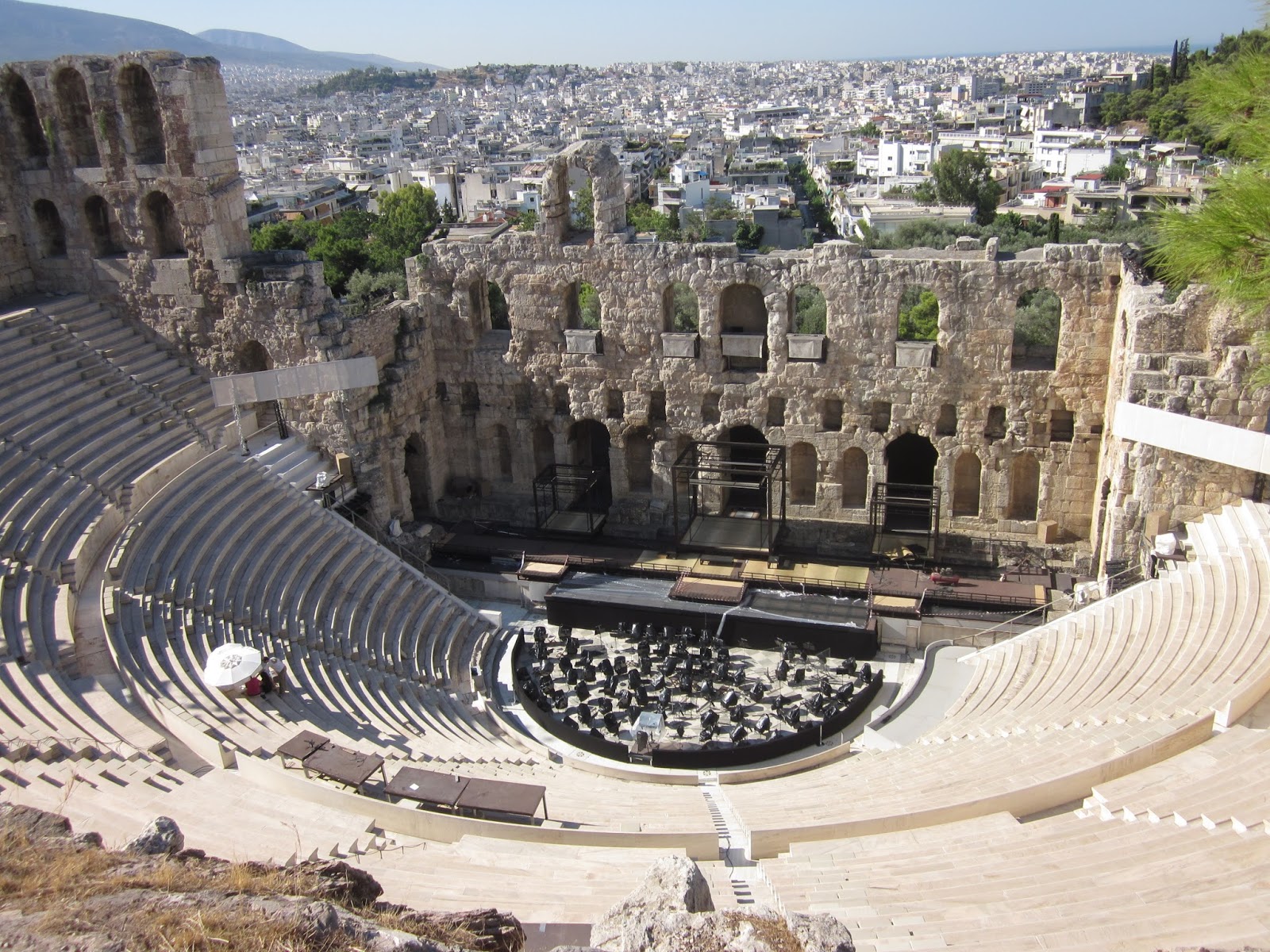
As we walked towards the Acropolis we saw what appeared to be some sort of performance venue that looked to still be in use today.  This venue is called the Odeon of Herodes Atticus.  Does that name sound familiar?  Herodes Atticus was also the man whom restored the Old Olympic Stadium.  He was a wealthy landowner, whom was a Greek with Roman citizenship. Though we might refer to this as a sort of Greek Theater, the Greeks use the term odeon, because it was used mainly for musical performances rather than theatrical ones.  Odeon comes from the same root as the English "ode", which is the Greek word for "song".  This large amphitheater built in Roman times seats 5,000 people.  The odeon was built in 161 AD by Herodes Atticus.


The Parthenon is the most important and most famous of the monuments at the Acropolis and even of all the Ancient Greek civilization.  This temple consisted of 8 columns on each of the narrow sides and 17 columns on each of the long sides.  Again...you cannot even begin to fathom construction like this until you are standing in front of it in awe of how something like this even came about so long ago in such a difficult location.


I don't know if you can tell, but the columns are actually formed by individual circular cuts...they almost look like bottlecaps. Here you can see it a little bit better.


The Erechteion is a Temple built on the part of the Acropolis that was considered the most sacred, for it was a sanctuary where the people worshiped the Gods, Athena, Poseidon and Erechtonius.  It is believed that in this very location a battle between Athena and Poseidon took place for the naming rights of the city...I think it is clear whom won that battle.  


There were three entrances to this temple.  The Porch of Caryatids (the six ladies), the north porch (behind the Erechtheion), and the east end (to the right of the caryatids). The Porch of the Caryatids is a balcony that has six beautiful maidens functioning as columns that support the roof.  All of the maidens nowadays are copies of the originals.  Four of the originals are housed in the Acropolis Museum and one was stolen in 1805 and the sixth is in France.  What amazes me about all of these monuments is the attention do detail.  All of the carvings and decorative borders are incredibly detailed.


The Temple of Athena Nike was built between 427-424 BC.  It is an almost square building consisting of 4 columns at both ends.  This temple used to house a statue of Athena holding a pomegranate, symbol of fertility, in her right hand and a helmet, symbol of war, in her left hand.  The term "Nike" in Greek means victory.  I somehow missed this temple going in, but caught it leaving, not aware at the time what it was.


I also didn't take a picture as we were entering the Acropolis through The Propylaea.  I did get one as we were leaving, but the entrance side is much more impressive with all the marble stairs leading up to the entrance.  We were with a guide and thousands of our closest friends on tours as well, so we were jammed in a tight group rushing to the Parthenon (to get the shaded spot...remember it was hot as Hades).  The entrance gate is called The Popylaea and is the monumental gateway of the Acropolis.The Propylaea was constructed in just 5 short years (437-432 BC).  Here is just a little of what I captured as we were leaving.


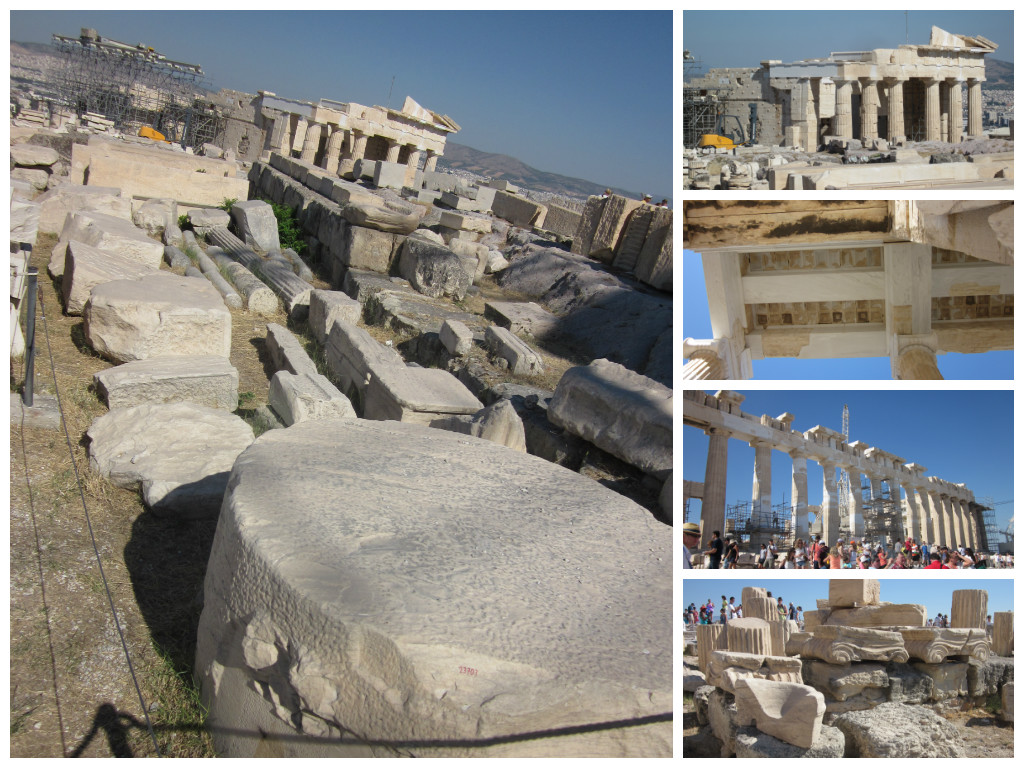
The Acropolis is incredibly old and with age (and war) comes deterioration and destruction.  Beginning in 1984 the renovation began on the Parthenon and some of the buildings surrounding it.  In many of my pictures you can see the modern day scaffolding and construction materials.  This renovation project first involves categorizing every single stone of the Parthenon.  Next, archaeologists hope to put the 70,000 piece puzzle back together again.  Whenever possible, original materials are being used.  New marble, cut from the same quarries, are being used to replace damaged and missing marble.  You can see is some of the pictures the "whiter" sections or patches.  With time these "patches" should age to become the same color as the old marble.


As you leave the Acropolis you leave through the Beule Gate.  This doorway was built by the Romans around 267 AD.  During Roman times this gate was the official entrance to the Acropolis, making the Propylaea entry even grander.


I also included a picture of an olive tree in this collage because Greece has more than 100 million of these trees. Olive trees are often called "the gift of Athena to Athens."

We were able to spend about 30 minutes in the little town of Plaka for souvenirs.  I will blog at the end about some of our finds along the way.  On our drive back to the boat I was able to just take in a bit of Athens.  I find that with each European city we visit I tend to notice little things quickly.  I found that Athens was quite clean and (in the areas we drove) lacked the graffiti that we see plastered on much of Madrid and other European cities.  There were also many Greek Orthodox churches.  Each church is a sight in itself. They were all ornate and beautiful with the quintessential dome adorning the tops of most if not all the churches. We were also able to get just a glimpse of the Temple of the Olympian Zeus.  According to Rick Steves, this is the largest temple in ancient Greece, which took 700 years to complete.  At completion, it was 360 feet by 145 feet, consisting of two rows of 20 columns on each of the long sides and three rows of eight columns along each end.  Though today, only 15 of the original 104 columns remain standing.


The beauty of having to get up early for an excursion allowed us to be back on the boat in time for a late lunch (though I was dying to find an authentic Greek gyro joint) and a little time for relaxation before we began cruising to our next destination: Kusadasi, Turkey, where we strolled the ancient Greek city of Ephesus and visited the House of the Virgin Mary.  And we thought the Acropolis of Athens was impressive...

Monday, August 5, 2013

Hot as Hades Tour Port 1: Messina, Italy


Our first port on our 7 night cruise was Messina, Italy, which is the third largest city on the island of Sicily.  We made it into port around 10 am.  This was a rare port for us because we actually made it to port a little bit later in the morning.  Normally, we arrived in ports in the wee hours of the morning and would wake up to being in a new spot, but this time we actually got to watch the boat dock itself, which is incredible.  It really is amazing what these ginormous ships can do.  Here was our view as we were docking:


Messina is located on the northeast corner of Sicily.  It is almost literally where the boot of Italy is kicking Sicily.  The body of water seperating Sicily from mainland Italy is called the Strait of Messina.

File:Italy location map.svg

We took the excursion off of the ship that went to Mount Etna and the little village of Taormina.  Mount Etna is an active volcano located on the island.  It is the tallest active volcano on the European continent.  It is 2 1/2 times taller than Mount Vesuvius.  Only Mount Teide, located in the Canary Island of Tenerife surpasses it's height.  We visited Mount Teide during Spring Break this year and so we were looking forward to seeing another volcano and comparing the two.

Mount Etna is one of the most active volcanoes in the world and is in an almost constant state of activity.


Our next top was a short one, but who can come to Italy and not try a cannoli.  The kids didn't love them, but I thought they were scrumptious. A little background on the cannoli.  It actually originated in Sicily and is described as a Sicilian pastry dessert.  Basically the cannoli is a tubed-shaped shell of fried pastry dough, filled with a sweet and creamy filling made from ricotta cheese.  Ours had a little sprinkle of pistachio nuts and powdered sugar as well.  


Our final stop on our excursion was the small town of Taormina.  This was such a picturesque little town. Our guide told us that this town is very popular amongst celebrities.  One of the main sites to see in Taormina is the Ancient Greek theatre.  This is one of the most celebrated ruins in Sicily, but unfortunately we didn't make it there.  We had two hot and hungry kids (and Chad) whom didn't want to trek the 30-45 minutes of our hour and a half stay, so food prevailed ruins this time.  It is said that Taormina has popular beaches along the Ionian sea and the water is remarkably warm and high in salt content.


This little town is certainly a location I could go back to and just RELAX near the water.  It was so beautiful...and hot!  We returned back to the ship with only an hour to spare before we disembarked for our next destination: Athens, Greece.  We had an "at sea" day in between Sicily and Greece and lost an hour of time, but I won't bore you with our day of relaxation on the ship. :-) So next up: Athens, Greece and the Acropolis.


Sunday, August 4, 2013

Cruising...The Ultimate Mom Vacation

Wow!!!!  Well we have just returned from an almost 2 week vacation in the Eastern Mediterranean.  We have given our trip a name, "The Hot as Hades Tour".  We were so blessed to be able to take a week long cruise beginning in Rome, Italy and going to 4 other ports and then extending our trip a week more to explore Rome and Venice.  I am going to blog about each location separately, but wanted to talk a little about taking a cruise.

Since being in Europe we have had the opportunity to travel quite a bit.  We have gone by pretty much all means of transportation...planes, trains and automobiles...but the ultimate is by far the cruise ship.  This trip was our second family cruise and I want to just give those travelers that have not considered a cruise as a means of transportation a little inspiration.

I am convinced that a cruise is by far the ultimate mom vacation.  Both of our cruises have been with Royal Caribbean and we are beyond impressed with all they have to offer.  They offer something for parents, singles, couples without children, retirees and even the kids.  Our kids absolutely love cruising because Royal Caribbean has an incredible program for the kids called, "Adventure Ocean".  This place is the bomb diggity for kids of all ages.  During "at sea" days, Adventure Ocean is open for most of the day to entertain the kids.  Basically...it really is a glorified childcare program, but the kids LOVE every second of it...and it is free of charge.  They play games, do science experiments, have friendly competitions, arts and crafts and so much more.  It is a place for all the kids on the ship to make friendships and do activities appropriate for their ages.  During "port" days Adventure Ocean does stay open for those children that do not wish to get off of the boat (or parents that wish to explore the port city without children in tow).  Adventure Ocean has sessions throughout the day.  They have the morning session (9-12), the afternoon session (2-5), the evening session (7-10) and the coveted late night party session (10-2 am).  The late night session is for a small fee, but that is when they have themed "party" nights.  Our kids literally wait outside the door until it is time for them to go in for each session.  They just can't get enough of it.  During our first cruise we learned very quickly how this could benefit Chad and I.  We made the kids come to the "fancy" dinner our first night on the ship.  These "fancy" dinners are basically a 3-5 course meal, depending on how much you want to eat.  The kids were full and fussy after the first course.  The kids much preferred the "buffet" style dining.  So from that point forward we would take the kids to the "buffet" style dinner and get them off to Adventure Ocean and then Chad and I could get dressed for our "fancy" dinner and have a quiet and enjoyable dinner, just the 2 of us, EVERY SINGLE NIGHT!  Wow....that alone is well worth Adventure Ocean.


The food...well you certainly cannot talk about a cruise and not include something about the food.  Our ship had multiple dining rooms.  The Windjammer Café is the "buffet" style of eating.  They had a breakfast spread each morning to include: made to order eggs, pancakes, waffles, oatmeal, sausages, bacon, assorted pastries, yogurts, cereals and really any thing you might have for breakfast, they offered. Lunch was usually different pizzas, salad and a ton of toppings, hamburgers, hot dogs, french fries, pasta and then a country theme.  The kids' favorite were the fish and chips days.  Dinner's in the café were actually pretty similar to what you might find in the main dining rooms, just in a much more casual fashion. They also usually had fresh sushi and an Asian inspired rice and/or noodle dish along with a soup.  They had soups and breads in the other part of the café along with a sort of tapas/antipasto assortment such as salamis, cheeses, olives and breads.  In the main dining rooms they also served breakfast, lunch and dinner.  We only really discovered what the dining room had to offer for other meals besides dinner on the last "at sea" day.  It appeared that there was actually a menu to choose from.  I don't know if it was the same each day or different.  I wish we would have discovered it and were able to utilize it more, but again, with the kids they prefer the buffet style of getting to choose what they want from a huge array of choices, so they were not happy the day we sat in the dining room for lunch. The dinner in the main dining areas are really a huge part of the "cruising" experience.  We opted for the My Time Dining option where we could make a reservation for a different time each night if we wanted to.  This also allowed for us to eat just the two of us each night, but I don't think we would have minded being with a group at times either.  I think half the fun of a cruise is all the different types of people from all over the world that are on the boat as well.  The dinner is a true multi-course meal.  You could choose a starter, soup and/or salad and an entrée or you could get multiple starters and multiple entrees if you wished. For me, it was too much food. I started out having a starter, salad or soup and an entrée, but by the end I was down to a starter and an entrée.  It was so much.  The starters usually included luxuries such as escargot, scallops, shrimp cocktail, crab cakes, and so much more.  There were usually 5 different choices of starters a night along with 2 different soups and salads.  Then the entrée...well they were all so yummy.  Prime Rib, lamb, steaks, pastas and again, much more. There was usually a theme in the dining room as well.  Depending on what port we were in influenced the ingredients.  Last, but not least...DESSERT!!!!  Holy Cow, like we had any room at this point.  All of the desserts were divine and I was not disappointed in any of the offerings, chocolate cake, cheesecake, chocolate mousse, key lime pie and on and on and on...

I think most people, myself included, are/were afraid of the whole cruising process.  It seems a bit daunting and can get expensive.  I think what I have learned is that it really can be as expensive or as cheap as you'd like.  Obviously it costs money, but there are so many stateroom options.  You can be in an interior stateroom, which can start at just $100 a cruise day/person all they way up to balcony suites starting at around $200 a cruise day/person and in all rooms I believe the 3rd and 4th passenger are at a discount.  No matter what sort of room you stay in you still enjoy all the same amenities as a cruiser staying in a fancier suite.  You still get all the same food options, can enjoy all the same shows, partake in all the same activities, lay out by the same pool and the list goes on.  We have opted for the balcony suites both cruises.  This is partly because we do spend time in our room.  I would much rather be in the sun reading my book on my own balcony then with a ton of people on the top decks, but I also take part in that experience from time to time.  Another expensive part of cruising is the excursions.  For ease and enjoyment we do usually book the excursions through the ship, but this is not necessary.  There are many books out there helping you plan your DIY excursion at many popular ports.  This can save a ton of money doing your own excursions.  Of course you will incur, possibly, depending on where you live, airfare to the cruise port location and any lodging before or after the cruise.

Another thing I think about when I am planning our cruises and "justifying" the price is what would it cost to do everything on our own.  On this last cruise alone we saw 5 ports spanning over 3 countries and a few islands associated with those countries.  If you tried to plan a trip seeing all the locations that you get to see on a cruise ship I think the cost would be much more expensive.  Cruising is one of the few vacations that I, a mom, can actually RELAX!!!!  I don't know that I ever really relax to that level.  The kids get to go to Adventure Ocean and play with other kids their age, we all get incredible meals prepared for us for every meal of the day (that I don't have to prepare nor clean up nor shop for), Chad and I get a "romantic type" dinner EVERY NIGHT, Chad and I actually get a few hours each day ALONE, we get to see incredible sights all around the world and I didn't have to plan out all the specifics of what to see and how and I can just sit on the balcony and read my book and watch the waves.  For those reasons alone this experience is truly PRICELESS!!!!!

I could go on for hours on the benefits of cruising.  I can't even begin to explain all there is to do on the boat itself.  There are multiple bars that appeal to different sorts of people, there are Las Vegas type shows every night, there is shopping and eating, casino, discos, spas,  our boat had an ice rink, rock climbing wall, miniature golf, basketball court, swimming pools, hot tubs and an inline skating rink.  The lists just go on and on.  We certainly have had the "ultimate" cruise experience just with the fact that we are already in Europe.  I can't speak much on the destinations from the states, but I will certainly be looking into it for when we return to the good 'ol U S of A.  I don't know if we will be able to squeeze in one more cruise next summer before we return, but we are going to try.  We really do love every second of it and hope that you will take a moment to look into it for yourselves.  Remember, there are many companies that provide cruises, many different destinations and if you choose and book early you can pay it off a little each month.

I hope you enjoy the idea of possibly planning your next vacation and coming soon you can read all about our incredible destinations...the first destination will be Messina, Italy on the Island of Sicily. I will tell you about our excursion to include a volcano, cannoli's and a cute little village overlooking the water.


Our ship was the Navigator of the Seas and was just incredible.

Thursday, February 7, 2013

Ceramic shopping in Puente Del Arzobispo

Holy Cow!!!!! Long time no hear/see from me. The good news is that we have been busy seeing and doing many things around Europe.  The bad news is that I am WAYYYYYYY behind in telling all of you about our great adventures. I am going to approach this catch up blogging as I would a scrapbook.  I am going to start with the most current and go backwards.  It has been over a year since I blogged last...so I have A LOT of catching up to do. :-)

I am not sure what you think of when you think of Spain.  I don't even remember what I thought of before I moved here.  Unfortunately, most European countries are not really in the "Marketing" business.  They don't recognize their "treasures" because they have done their certain trade for generations and generations.  It is just their way of life.  Living in Madrid now for just over 18 months, we as foreigners, hone in on these "treasures" pretty quickly and the American in us wants to business plan for them because we recognize how unique their products are.  They don't see it as such.  The "treasures" I have discovered while living here so far: olive oil, wine, jamon, olives, Manchego cheese and ceramics, to name the highlights.  This time around I am going to tell you what I know and love of the ceramics here in our region of Spain.

This past week some friends and I took a trip to one of our favorite places to buy ceramics.  If you didn't know about this "treasure" of a place you would never in a million years locate it.  It is in a little town called Puente del Arzobispo located about an hour and half south of Madrid. This unassuming little town is full of ceramic shops...(and cake, well that is for another day).  There are actual storefronts, and then there is De la Cal.  Now, when it comes to the ceramics in Spain you can almost tell where a piece is from just by the design and colors. Each family has its own unique pattern and style of painting...yes all these pieces are still painted by hand.  De la Cal has their own pattern and depending on where they are shipping the items depends on the colors.  For instance, the little town of Segovia, located about an hour north of Madrid, gets some of their pottery from De la Cal and they have their own color scheme called...wait for it...Segovia. :-0 

 
 Here is the glamourous entrance to De la Cal.  See what I mean...would you ever in a million years be able to find this. Never judge a book by its cover.  What lies inside this faded, rusty gate will knock your socks off.  Let me give you a little background on De la Cal...well...as much as I know.  They are a family of five generations that have hand painted and still hand paint beautiful pottery. They do have some large clients.  They do ship all over, but I am sure you would have to order enough to make it worthwhile for them.  One of their big clients is Columbia Restaurant in Florida.  Now, I may be mistaken, but I think this restaurant is the oldest restaurant in Florida.  If you google Columbia Restaurant and go to their shop tab...you will see De la Cal's Sangria Pitchers made just for them.  I of course have a picture as well below.  These were getting ready to be shipped out.  The woman in charge now, Ana, is phenomenal and the sweetest thing going. What I always notice from these types of families is that their work ethic is outstanding.  They work extremely hard and are very accomodating.  In the winter their factory is freezing cold and in the summer it is excruciating hot. I am sure they do all they can to keep costs as low as possible.
 
 
Now to show you and tell you about their "treasures".  What I especially love about De la Cal and what makes them "unique" to me is that they will customize any of their pieces in whatever colors you want...and if it is a successful color scheme they just might name it after you.  The color schemes that I know came about because of  the "Americans" and I think one "Brit" are the Tiffani, Ashleigh and the Belinda.  The first time I went to De la Cal I brought pieces of my current dishes for them to match.  Though, of course, it turned out beautiful, it just wasn't exactly what I was looking for.


 So, this was my first round.  I still love these pieces and will use them, well have used them, but wait til you see the others.  I will save that for in just a little bit.  I want to show you a little of their warehouse.  It is located on, what appears to be, a little farm. When you come in this big green gate they have chickens and dogs pinned up.  It is just so "typical" really.  They might live right on the property, I am not sure.  You walk up a fairly long dirt driveway to get into their warehouse.  When you arrive in their warehouse there is pottery everywhere.  They have pieces that are formed and drying, pieces waiting to be painted, pieces waiting to be fired, pieces that have been ordered and are waiting to be picked up and pieces waiting to be shipped out...all on this main floor of the warehouse.
 
 
They also have an upstairs.  On the upper floor they have pieces that you can purchase right there...I suppose you could think of it as an "outlet" or maybe even the "seconds" so to speak.  Maybe these are pieces that didn't pass their quality control test to be sent to a customer or maybe the customer decided it wasn't to their liking or maybe they are "discountinued" patterns or types of pieces or have some small defect.  I am not sure, but it is always fun to go up and look around upstairs.  It is extremely dusty up there, but you never know what you will find.


I cannot even put in words how much I love this place.  You can sort of tell by these pieces what their signatures are.  The flower on the vase on the right is one.  You can also see this flower in my platter above.  Another signature are the arches with a design within the arch.  This is seen throughout their sangria pitchers, vases and copas.  Some traditional pottery designs of Puente del Arzobispo are bird and hunting scenes.  De la Cal does these as well.  I believe their signature colors are blue and yellow, which you will see below, but like I said that have created some amazing pieces for us "Americans".  If you were to go to their website you would see mostly these types of peices:


This is a sort of fancy filigree design.  It looks very regal to me.  I bet it is quite the story to hear about how they came up with their "signature" design.  Speaking of designs and colors...many of the "Americans" or foreigners in Madrid, per se, order the Tiffani style.  Tiffani was an American whom lived here and wanted a design that reminder her of Spain.  She basically started with the idea of the colors of the Spanish flag and left that idea with the painters and designers at De la Cal.  The pattern and colors have evolved over the years and, of course, each piece is different.  My most recent pieces are a little different from the pieces people have gotten a few years ago.

Sangria pitcher, personalized, along with copas

Tres pisos frutera.  Three tiered.

Close up of the Sangria Pitcher.
 WOW!!!!!!  If this doesn't scream, "I am from Spain" then I don't know what does.  Isn't this one of the most beautiful sights ever... The pattern seems to have evolved to be more colorful throughout the years.  I am guessing because people have requested all sorts of color combinations and they are not about to waste their resources, so they start to use the colors they have, to make it even better.  As we spoke to Ana this time she mentioned to us that we have an "exclusive" color scheme.  She does not offer these color choices to her mainstream clients, though she should becasue they are beautiful.  You have to know what the color scheme is named in order to place your order.  I suppose Europeans are not as flashy as Americans so they are drawn to the much more subdued tones.  What is the saying...Go big or go home. 

Here is an example of the Ashleigh:


Again...holy cow are you kidding me...beautiful.  This color scheme came about when "Ashleigh" was ordering pottery for a wedding gift in the colors of the wedding and now she has a pattern named after her.  Pretty cool!!!! 

Another fun little fact about the pottery in Spain is that each piece has the idea of a signature.  I like to think of it like art...each piece is signed, in one way or the other, by the artist.  The signature basically is the family name or business name and the region or location.  Here are two examples of what De la Cal does:

 
Here you see Ceramica De La Cal (family), Puente Del Arzobispo, Toledo, Espana (location) and Hecho A Mano (Made by Hand).  I have just recently noticed this stamp on their items. It may be new or maybe just on larger pieces.


Again...De la Cal (family), Puente and Espana (location).  These are hand painted on most of the pieces that I have.  I only have one piece with the stamp.  We shall see what comes on the pieces that I just ordered.


One other favorite stop of ours when we are in Puente is Cruz Ceramica.   At Cruz you cannot special order items and if you are there and see something you like you better buy it because it might not be there next time and they might never make it like that again.  The Cruz store we go to is run by two sisters.  There storefront is filled with beautiful things, but if they really like you, they let you go to the back warehouse where they house all of their "treasures".  I think if you just walked in off the street, again, you might never know they have a warehouse full of all kinds of things in the back.  We literally pull up cushions and sprawl out on the cement floor digging through the stacks of platters and bowls and whatever we feel like, looking for the "perfect" piece for us.

Here are some Cruz pieces that I have:


Notice right away the difference in both pattern and color designs. Cruz is very intricate and we actually got to observe one of the sisters hand painting a platter.  It is very time intensive as you can clearly see.  The more times we go back it is apparent that they are training the next generation of painters.  The younger generation is a bit more "free" as in the square platter, yet the older generation likes their clean lines and symmetry.  Also notice the CRUZ signature.  They don't specify their location, but most signatures do.  Another little detail on all the platters and some bowls I have noticed, is they are designed with little holes on the back, within the base, for hanging on a wall.

The ceramics are by far one of my favorite things here in Spain and I am sure to leave with quite the collection.  Like I mentioned before, depending on where you purchase the ceramics, the colors and styles will vary.  I will save a comparison of pottery from different regions for a later post.  Today you have just visited Puente Del Arzobispo.  I don't want to overwhelm you all.

Coming from a country where just about everything is mass produced or made in China it certainly is a breath of fresh air to see these amazing small businesses in Spain that are still deeply connected to their roots.

Until next time...